Filumena (1946) – not to be confused with the 2013 film Philomena – is part escapist entertainment, part tragic-comedy and part Chekhovian-inspired serious drama. Whilst it doesn’t quite reach the tragic-comic sweet spot of Chekhov’s unique oeuvre, it is nonetheless thoroughly entertaining and certainly worth a couple of hours of viewing time. I saw it last night at Richmond and I have to say I was enthralled, intrigued and beguiled. As we head into a bleak dark cold winter, why not be transported to the sunshine and laughter of Naples?
Filumena is a wonderful opportunity for the evergreen Felicity Kendal to demonstrate why she remains one of our most accomplished actors. If in the 1970s TV series, she tried to live The Good Life in Surbiton, in Filumena she attempts to live A Good Life in Naples. The play is about Filumena’s struggles to get out of poverty and make a new life for herself by marriage to the aristocrat Domenico Soriano (Matthew Kelly). Filumena is a Cinderella and ex-courtesan who, through guile, wit and sheer determination, manages to escape the slums of Naples and become the Lady of the House. It is, as it were, the exact reversal of Ibsen’s A Doll’s House. Where Nora wants to escape domesticity and security, Filumena wants to get inside the house and embrace domesticity and financial security.
Like the title character in Shaw’s Mrs Warren’s Profession, Filumena is an ex-courtesan but the secret is out. Filumena’s main client is her husband. The tension in the play is provided by Filumena’s knife-edge strategy of keeping on the right side of the bullying and dictatorial Domenico. Unless she can walk this tightrope, her whole life’s mission (which I can’t mention here as it would spoil the play for you) is threatened. The fascination for us in the audience is in seeing how Filumena pulls it off, to quote Denise Deegan’s 1983 comedy (Daisy Pulls It Off).
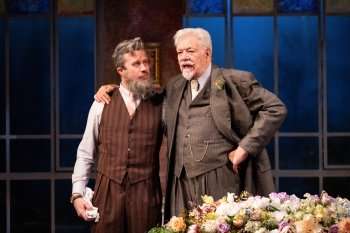
Her husband Domenico is domineering, dictatorial and self-dramatising. A bully, a womaniser and a narcissist, he is no pushover and it is her battles to outwit and outthink him that provides the play with its central clash of wills. The back and forth between these two is dizzying in its topsy-turvy twists and turns. Now one, then the other, has the upper hand. As the Duke of Wellington said of the Battle of Waterloo, it was a damn close-run thing, and the same can be said for Filumena’s battle against Domenico. The verbal sparring is good in places, spoilt by some overly long monologues. There is some marvellous descent from danger into farce – as, for example, when Domenico threatens to shoot Filumena, he goes to the dresser to get his revolver but can’t find it. He is reduced to asking his manservant about its whereabouts. He tells him it’s gone to be repaired as the barrel is rusty. Clearly, a phallic reference to Domenico’s equipment.
The play has ambitions as if it were the Italian Chekhov. The scene with the revolver comes close. But all too often the play is nearer an Ayckbourn farce than a Chekhovian tragicomedy. Nothing wrong with an Ayckbourn farce, but Filumena falls between the two. Only at the end, having accomplished her mission, does Filumena reach the depths of emotion that the play has been attempting to convey. It’s a wonderful and moving scene (which Felicity Kendal delivers felicitously) but one moment of heightened emotion does not a Chekhov make.

Review by John O’Brien
Amidst the heat of a Neapolitan spring, Filumena Marturano (Felicity Kendal) lies on her deathbed, waiting to marry the man who has kept her as his mistress for twenty-five years. No sooner than they are married, she makes a miraculous recovery, much to the surprise of her new, unwilling husband and his younger lover!
Also joining Felicity Kendal as Filumena will be Matthew Kelly as Don Domenico and Julie Legrand as Rosalia, George Banks as Michele, Gavin Fowler as Umberto, Jamie Hogarth as Alfredo, Ben Nealon as Nocella, Lee Peck as Waiter, Fabrizio Santino as Ricardo, Jodie Steele as Diana, Hilary Tones as Teresina and Sarah Twomey as Lucia, with Eliza Le Touzel Teale as the understudy.
Written by Eduardo De Philippo
English Version by Keith Waterhouse & Willis Hall
Directed by Sean Mathias
Set design by Morgan Large
Lighting design by Nick Richings
Bill Kenwright Ltd and Theatre Royal Windsor present
FILUMENA
Richmond Theatre, The Green, Richmond TW9 1QJ
Tuesday 19 to Saturday 23 November 2024

