Gigenis, The generation of the Earth at Sadler’s Wells is a production that thrills with its visual sensitivity, beauty and exploration of mythical qualities. The scene as the show opens suggests a sacred place in another time, perhaps Queen Hatshepsut’s temple in Ancient Egypt or a sanctuary of a Greek god, a temple in India. Describing effectively by this ambiguity the resonance and roots of humanity that are shared. Gigenis means gigantic in Urdu. The themes expressed in this show are indeed gigantic, expanding across myth and the repetition through human time of the continuing destructive quest for power irrespective of consequences, the tragedy of war, a disregard for nature.
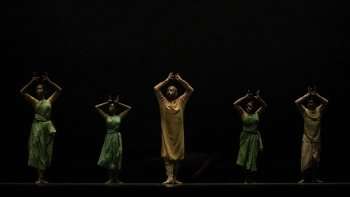
The story told is inspired by the Mahabharata, an ancient epic tale of power, greed, loss, joy and fear that takes place within a family. The mother is the central figure telling the story as her two sons interact, one seeking power regardless of whatever destruction this causes while the other wants to surrender to the power of nature.
There are seven incredible cross-generational performers on stage to describe this story including Akram Khan and Mavin Khoo, also well known to British audiences. Another artist is Kapila Venu, who is not a dancer as such but a practitioner of an ancient and rare theatre tradition called Kutiyattan from Kerala, India. UNESCO has officially recognized Kutiyattam as a ‘Masterpiece of the Oral and Intangible Heritage of Humanity.’ Venu’s performance here is an affecting marvel.
Each of the performers is a master of different classical Indian dance forms. Well established in India but, apart from Khan and Khoo, not yet known in the international dance world they are extraordinary. Their delicate movements of arms, hands and fingers are a revelation as they create images such as flowers blooming or grasses in the wind, bare feet moving with precision at astonishing speed, bodies clothed in traditional Indian costumes sensuous as they weave and bend. Gigenis is not only a performance of soloists, when these performers work together they display unforgettable synchronicity and power.
Akram Khan is a vital, global dance figure. It’s moving to see him back on stage dancing again as an older self, not lessened. With this production in which he was director, artistic director and choreographer he has done Western dance yet another creative favour, bringing these enormous classical Indian dance talents, their skills, traditions and imagery into view globally. He has said, this is not about giving these wonderful artists an opportunity to perform in the west but about giving his audiences an opportunity to see such artists.
The accompanying music and sound performed live by seven musicians is as impressive, much of the score being original. There comes a point when it becomes apparent what’s being played is more than an accompaniment, it is capable of standing alone in excellence. At one point there’s the astonishing sound of combined human voices in some unknown language which has the same fundamental resonance as a chant has when sung in Ancient Greek. Taking us once again back to myth and the shared essence of our humanity.
The lighting design by Zeynep Kepekli brilliantly chimes with the mythological scale of this show, creating a gorgeous illusion and essential atmosphere.
With the show’s sublime beauty, exciting creativity, talent and scale of aspiration this could be expected to be a five-star review. It’s not but only because there’s an opaqueness in the communication of the story and consequently links between themes. The Mahabharata is an Indian work not known to everyone in a Western dance audience. For those watching the show without having the opportunity of consulting the very informative programme confusion can arise as to whether the show is about the birth then ruination of our planet as appears likely initially before it turns into a story of family struggle. It is possible not to appreciate that one brother, importantly, wants to surrender to the power of nature, continuing that theme. When known this does help to tie the show together.
A beautiful show of exceptional talent.

Review by Marian Kennedy
A choreographer and dancer rooted in the tradition of his practice, and a creative interpreter of stories that need to be experienced – Akram Khan has revolutionised the world of dance.
Khan returns to his roots, to his traditions, and to his past – to a time when we were more connected with nature, Mother Earth and our mythology. GIGENIS evokes the memories of our civilization.
In his new artistic chapter, Khan shares the stage alongside an ensemble of six renowned artists of Indian classical dance and seven live musicians.
Dancers
Akram Khan
Sirikalyani Adkoli
Renjith Babu
Mavin Khoo
Mythili Prakash
Vijna Vasudevan
Kapila Venu
Musicians and Vocals
BC Manjunath (percussions Mridangam)
Kalamandalam Rajeev (percussions Mizhavu)
Hariraam Lam (violin)
Nina Harries (double bass)
Sohini Alam (vocals)
Chitra Poornima Sathish (vocals)
Rohith Jayaraman (vocals)
Director Akram Khan
Light designer Zeynep Kepekli
Music orchestrator Jyotsna Prakash
Sound designer Dave Price
Sound Engineer Mark Webber
Rehearsal director Nicky Henshall
Technical director Michael Cunningham
Stage Manager Marek Pomocki
Costumes Peggy Housset
Producer Vony Sarfati
GIGENIS: THE GENERATION OF THE EARTH
Sadler’s Wells Theatre
Wednesday 20 to Sunday 24 November 2024

