Boing, boing, boing. Back and forth the narrative goes, time-hopping between different periods of the life and times of Mary Lincoln (1818-1882) (Miriam Grace Edwards), and it’s not seldom immediately obvious quite when each scene is set. An added complication comes about by way of Lincoln’s mental state, and like so much in this play, it’s unclear whether she really was in need of therapy of some kind – or, as things were done in the nineteenth century, a spell in the asylum – or if she simply had a particularly active imagination.
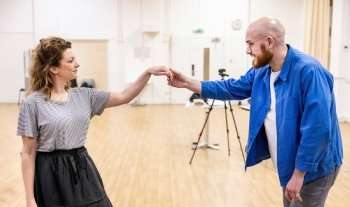
At a time when senior political figures in Britain are under fire for making use of public money for hiring personal photographers, a show that attempts to document some of the photography of Mathew Brady (Sam Jenkins-Shaw) happens to be rather timely. Brady, or at least this production’s version of him, generously boasts of how many US presidents and other politicians he had photographed. But you can forget what some people in the theatre industry refer to as ‘historical verisimilitude’. As soon as Lincoln and Brady disappear, an old-style camera starts engaging in dialogue with a wooden chair. We even get the chair’s backstory (spoiler alert: it used to be a tree).
It is, therefore, difficult to take the show as a whole seriously, which is frankly a bit of a shame, as the storyline had the potential to be something quite profound. The audience is instead subjected to observations such as the one about the camera’s quality deteriorating over time as Brady makes heavy use of it over the years. Is it even Brady who takes every photograph? Lincoln points out Brady’s poor eyesight, though Brady, ever the alpha male, insists his photography speaks for itself and his pictures will put Mary Lincoln in the history books for generations to come.
The introspective nature of the narrative doesn’t allow for any consideration of how American society at large perceived Mary Lincoln, positively or otherwise. The special effects in the show are good. I would elaborate on that point but doing so would be giving too much away, so what I’ve deemed ‘good’ will have to be good enough. The costumes (Gregor Donnelly) are suitable for the period, as far as I could tell, although I am open to correction, not knowing the intricacies of 1860s American high society fashion.
Brady has other clients, though I didn’t really see much point in including them – they appear fleetingly, never to be referred to again. I’m sure an entire other show, for instance, could have been written about the life and times of John James Audubon (1785-1851), an artist and ornithologist – a couple of minutes of broad brushstrokes and an absurd ‘French’ (inverted commas mine) accent just doesn’t do the man justice. Such is the use of creative licence in the script that I came away not sure whether any of the details are to be taken at face value. Perhaps that was the show’s point – trust no one.

Review by Chris Omaweng
In Mrs President, Mary Lincoln is a woman at war—with her grief, her detractors, and herself. Vilified by an envious elite and accused of treason, she strives to rebuild her public image to win the hearts of the American people. She turns to the world’s first celebrity photographer, Mathew Brady, who helped her husband, Abraham Lincoln, win the presidency. But their partnership unravels into a tense battle for creative control. As Mary fights to tell her story, the play delves into themes of power, identity, female agency, and the cost of representation.
CAST
Mary Lincoln: Miriam Grace Edwards
Mathew Brady: Sam Jenkins-Shaw
CREATIVE TEAM
Written by John Ransom-Phillips
Directed by Bronagh Lagan
Movement Director & Associate Director Sam Rayner
Set & Costume Design by Gregor Donnelly
Lighting Design by Derek Anderson
Sound Design by Sonum Batra
Video Design by Matt Powell
Production Management by Dan Weager
General Management by Katy Lipson and Kristie Winsen for ARIA Entertainment
MRS PRESIDENT
Charing Cross Theatre
31 January to 16 March 2025

