There can be few people completely unfamiliar with the tale of Animal Farm. A stalwart of generations of set English Literature and political studies texts, this savage allegorical satire, based on post-revolutionary Russia and the rise of Stalin, remains a seminal work of literature.
The tale has been told in a number of stage productions and other media incarnations since it was written in 1945, one of the most memorable being the famous 1954 Halas and Batchelor animated film.
Any group taking a fresh look at such a well-known fable is faced with the challenge of incorporating something new and innovational in their approach.
Ian Woolridge’s stage adaptation, directed by Iqbal Khan for Octagon Theatre, certainly looks to do this.
Ciaran Bagnall’s oppressive set design features harsh white lights and blinking red CCTV surveillance cameras emphasising the unyielding industrial corrugated iron doors that symbolises an uncomfortable, chilling, dystopian world far removed from any rural idyll. There is something of the abattoir about this set, prefiguring the violence and bloodshed to come.
The clever use of surveillance imagery not only underscores the narrative of the farm’s descent into rigid authoritarianism, but also represents a subtle acknowledgement of Orwell’s other great work of manipulation, coercion, and psychological control, “1984”. Big Brother is very much present in this production.
The audience are discomfited and disoriented by this stark visualisation, as they are intended to be.
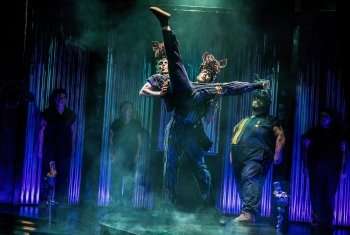
The opening scenes are disturbing. The actors squeeze out of their pens and stalls and slowly clamber over each other, glaring at the audience and each other, noses in the air, ever watchful and on edge, occasionally pawing at the ground. Their staccato movements are accompanied by a cacophony of guttural squeaks, squeals, and screeches.
Su Newell’s costumes are well realised. They blend a practicality with clear symbolism. Skeletal headpieces are worn by the actors to identify the animals that they are portraying. There is nothing soft or cuddly here, just a representation of stark skeletal headwear. Simplistic but visually powerful.
The ensemble delivers a series of performances which generally complements the visceral power of Orwell’s fable, with the actors taking on multiple roles easily and deftly and rise to the challenge of ensuring that their movement and facial expressions blur the demarcation lines between animal and human. Particularly striking is the subtle transition in the pigs’ movement where, as the narrative develops, they become more upright and two-legged, eventually entering the final scene on stilts like deformed zombie hybrids.
Sam Black’s portrayal of the Stakhanovite Boxer is a particular highlight. He captures the cart-horse’s strength, loyalty and naivety in a way that makes his ultimate fate deeply moving.
Natalia Campbell brings gravitas, warmth, and honesty to her dual roles as Old Major and Clover, embodying both the hope of revolution and the subsequent despair of betrayal.
The superb characterisation of the world weary, cynical donkey Benjamin, who knew exactly what was coming, and delivered his thoughts in a gruff, Tony Hancock-like, manner was especially striking.
Olivia Chandler’s flirty, flighty, and materialistic Mollie, obsessed with her looks and her penchant for sugar lumps and ribbons, provides a much-needed lightness to the narrative.
Indeed, there are some moments of humour which bifurcate the sense of the totalitarian noose tightening. The pigeon describing how she saw Napoleon flat out and snoring on a bed in the farmhouse, and the audience being addressed as a flock of intellectually challenged sheep during the introduction of the famous “Four Legs Good, Two Legs Bad” mantra raised a smile.
Adopting such a radical reinterpretation of a revered literary classic is not without its dangers. The challenge of capturing all the nuances of the relationships between the animals, and the eventual betrayal of the idealistic nature of the Animal Farm enterprise, resulted in an uneven treatment of the narrative.
One of the more shocking and memorable features of the original story was the adoption and training of the dogs to act as the vicious enforcers of Napoleon’s strategic hegemony. This was not covered in this production, whilst the denunciation and subsequent flight of Snowball was rather glossed over.
Whilst the pean to Sugar Candy Mountain as the heavenly resting place for all animals was amusingly delivered in the style of an American religious evangelist, this sequence went on too long.
This production’s concentration upon dystopian bleakness, and the emphasis upon disillusionment and ultimate betrayal, represented a considerable challenge to the establishment of those subtle nuances between the animals which helps drive the narrative.
Some of the speeches, especially later from Napoleon, were overly hectoring and declamatory, rather than being layered with calculated obfuscation and implied threat, and battered the audience into a one-dimensional submission.
Similarly, whilst Squealer, the arch propagandist, effectively used lies, fear and mind-numbing statistics to cow and manipulate the other animals to support Napoleon’s bidding and accept the blatant untruths, we did not see enough of his subtler armoury of wheedling, cajoling, “all in this together” persuasion that would have made his peremptory closing down of all discussion of Boxer’s ultimate fate more shocking.
At times, it was difficult to avoid the feeling that we were watching individualistic scenes and chapters playing out, rather than a smooth flowing narrative of spiralling events resulting in the shocking and depressingly premeditated denouement.
For eighty years Animal Farm has captivated readers and audiences with its powerful exploration and savage indictment of power dynamics, greed, political manipulation and societal change and inequality. It continues to spark conversations about, and reflections upon, justice, community, leadership, and the fragility and corruption of ideals.
This production attempts to address the essence of Orwell’s narrative and succeeds in reminding us of the enduring relevance of his warnings; of hope and optimism being fiercely crushed by extremism and brutal self-interest. A message still, sadly, relevant in our own time.

Review by Johnny Oxford
A powerful re-telling of George Orwell’s chilling and timeless classic.
When the downtrodden animals of Manor Farm overthrow their master and take over, they imagine it is the beginning of a life of freedom and equality for all. However, over time a cunning and brutal elite among them, masterminded by the pigs Napoleon and Snowball, gradually take control. Soon the other animals discover that they are not all as equal as they once thought and find themselves ensnared as one tyranny is replaced with another.
Orwell’s enduring and devastating satire about the corruption of power is brought vividly to life on stage in this compelling critically acclaimed production.
The cast includes Sam Black as Boxer; Natalia Campbell as Old Major and Clover; Olivia Chandler as Mollie; Lewis Griffin as Squealer; Soroosh Lavasani as Snowball; Rhian Lynch as Napoleon.
Completing the cast is Kai Spellman as Male Swing as well as being Associate Director for the production, and Heather Porte as Female Swing.
The full creative team will be returning for the touring production, including Iqbal Khan (Director); Ciaran Bagnall (Set and Lighting Designer); Gerry Marsden (Sound Designer); Su Newell (Costume Designer and Supervisor); Shelley Eva Haden (Movement Director); Dylan Towley (Composer).
ANIMAL FARM
A co-production between Theatre Bolton, Derby Theatre and Hull Truck Theatre
Rose Theatre Kingston
4 to 8 February 2025
This tour of Animal Farm commenced at Octagon Theatre Bolton (22 January – 1 February). Following performances at Rose Theatre, the show tours to Malvern Theatre (11 – 15 February), Curve Theatre (25 February – 1 March), Queens Theatre Hornchurch (4 – 8 March), Yvonne Arnaud Theatre (11 – 15 March), Perth Theatre (25 – 29 March) and Liverpool Playhouse (1 – 5 April).


Beautifully said Johnny, though with the fine, hyper-sensitive skills of a theatre critic. However, for a lay-audience it was more than sufficient to convey the spirit of Animal Farm and its purpose in a lucid manner, along with little touches of the American accent of Moses the Raven, the awkward “ticks” of the pigs as they knew they were being hypocrites, and to their final metamorphosis on stilts when they conveyed they had no care for anything other than preserving their own interests. What an amazingly appropriate time to put this on – a reflection of reality.
The cast, set, direction and production were as good as is humanly possible to convey the story. What a timely choice by Octagon Theatre Bolton to come to Kingston Rose Theatre! I ensured the other 4 members of our family party read and re-read Animal Farm. The soul of George Orwell certainly had inspired the whole production. It should of course be in the core curriculum for English in order to educate, inspire and awaken our young.