It is AD61. A fractured and largely subdued Britannia is under the heel of Roman subjugation.
Prasutagus, leader of the Iceni tribe, who has ruled via an uneasy accommodation with Rome, has died and split his kingdom in two, giving half to the Roman authorities, and half to his estranged Queen, Boudica.
Although Rome has allowed certain local rulers a degree of nominal autonomy, it is clear where the balance of economic, and military power lies.
Boudica’s appearance at the Roman epicentre of power to claim her rights as Queen is peremptorily and shockingly denied. Banished from the kingdom, brutally flogged, her daughters violated, Boudica pledges to return to wreak revenge upon the Roman invaders, and avenge the wrongs meted out to her, as both a Queen and as a mother. Indeed, it is Boudica’s fierce, uncompromising love for, and devotion to, her daughters that will outweigh every consideration of policy, estrange her allies and, ultimately, lose the war she wages.
Tristan Bernays’ retelling of the legend of Boudica debuted at Shakespeare’s Globe in 2017. Historical sources detailing the story are scarce and are drawn exclusively from the Roman perspective. This allows playwright Tristan Bernays to move from the meagre facts available and imaginatively create a narrative that tells the tale from Boudica’s perspective, seeking to flesh out the story of this iconic yet elusive historical figure. The main focus rests unequivocally on Boudica’s experience as a powerful woman in a man’s world and the competing demands on her as a mother and a ruler.
There is a distinctly Shakespearean feel to the production, with a number of references within the characterisation and narrative to works such as “Cymbeline” and “Antony and Cleopatra”, especially in Boudica’s final moments, which prefigure the fate of Egypt’s great, tragic Queen.
We even have a scene-setting Goddess chorus at the start, Andraste, to anchor subsequent events and appear once more as the play reaches its denouement.
Then we are straight into the action, with a trio of Roman sentinels bemoaning their posting in “…this sad, frigid island” before we encounter the Procurator of Britain, Catus Deciamus, presiding over, and controlling, a drink-soaked grouping of tribal British kings,
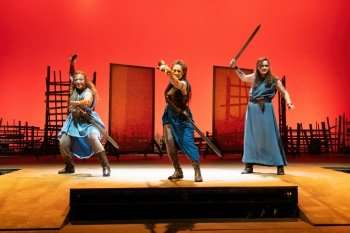
The arrival of the uncompromising Boudica and her daughters, Blodwynn and Alonna, and their subsequent treatment, upsets the fragile peace, and precipitates a series of violent, bloody clashes between the British tribes and their Roman masters, with Boudica at the centre of everything, using a combination of force, persuasion and guile to, initially, avenge the wrongs committed against her and her daughters, but then, subsequently, to drive the Roman colonisers from the island.
Boudica is an ambitious play, with many fast-moving scenes, violent pitch battles and high-tempo declamatory and often anguished, angry speeches.
The action and emotion are relentless, and the narrative sometimes becomes overwhelming, as one character after another, in the heat of battle or frenzied oration, shouts, rants and raves a little too much, bludgeoning the audience, as well as the enemy, into submission.
Subtlety is certainly at a premium throughout this production, yet the overall effect of the narrative would have been improved by allowing a little more reflection and stillness into some of the scenes. Those episodes where the temperature was turned down to enable a more thoughtful exposition of vulnerability (for example, when Alonna was expressing doubts about the morality of continual death and destruction, or when Boudica plaintively asked one of her fighters, “What would you do in my place?”) stand out strongly.
The pace and power of the production also meant that some actors were facing away from the audience, which caused problems with the clarity of the diction.
The linguistic register was occasionally jarring, with an overuse of ribald swearing sitting uncomfortably with the more descriptive dialogue. A little judicious cutting would also have improved the drive and impact of the narrative thrust. The songs, for example, seemed to add little to the course of the action.
There are some meaty, challenging roles in this production.
Hannah Victory, as Boudica, astutely demonstrated the contradictions in the Queen’s character. Her nobility, independence and ambitious self-confidence are well portrayed, as is the softer vulnerability of her relationship with her daughters. A performance of authority and controlled feeling.
Boudica’s daughters develop throughout the play into two very different characters, and the actors portray these changes convincingly.
Sophie George’s Blodwynn is fearless and single-minded, enthusiastically taking the struggle to her enemies, and having no doubts about the fundamental rightness of her cause and actions.
Contrastingly, Kerala McGrail as Alonna, the younger sister, sensitively portrays the doubts and confusions that shape her own, very different, compassionate response to the bloodshed and the escalating violence. Her scenes with Silvia, an innocent citizen caught up in the mayhem of the sacking of Camulodunum (modern day Colchester), are especially memorable.
Particular plaudits, too, should be given to Antony Curran, who gave us a moderate, thoughtful Cunobeline, with a keen sense of loyalty and realpolitik. The contrast here with the ferocious, boorish, aggressive Badvoc, energetically played by David Erdos, was especially striking.
On the Roman side, Darren Chancey’s Catus Deciamus was a master of slick casuistry, whose apparent reasonableness was belied by his violent and uncompromising treatment of Boudica’s claims.
David Hovatter’s Gaius Suetonius gave us a cold yet clear-eyed professional soldier, whose contempt for the British tribes (and any suggested political compromise in Rome’s dealings with them) was crystal clear.
The set was, appropriately, bare and relatively uncluttered, providing an unencumbered space for the various battles to be played out. The use of coloured block lighting projections on the backdrop screen (with an obvious preponderance of red!), and a mystical music score punctuated by portentous drumming, were complementary to the action. Costumes were appropriate and added to the verisimilitude of the production.
Boudica is a play with a number of political themes, messages and parallels for a 21st-century audience who wish to examine them. Whether that be the rights and wrongs of resistance to an occupying force, the question of political identity and the concept of sovereignty, the killing of innocent people in the furtherance of a “just” cause is down to the individual. As Questors director David Emmet rightly points out in his notes, when the play first premiered in 2017, many thought that it was largely about Brexit.
At its heart, though, it is a fast-moving, visceral and challenging reinterpretation of one of the most enduring legends from British history.
Questors are to be commended for accepting and rising to the challenge of putting on this play, and their hard work and commitment to this production deserve to be seen by good audiences.

Review by Johnny Oxford
She will have revenge. She will have blood. She will make Rome quake in fear.
A fractured Britannia cowers under Roman occupation. The King of the Iceni tribe has died and his widow, Boudica, is denied her rightful kingdom. Flogged, banished, her daughters raped, Boudica returns with an army to unite the tribes against tyranny. Britain’s rebel warrior is out for revenge as a queen – and as a mother.
A thrilling reinvention of the story of Boudica, this spectacular production places women at the centre of the action as the two sides clash in a series of epic battles.
BOUDICA
The Questors Theatre
2 to 10 May 2025

