Well, it’s different, I’ll give it that much. The three acts in this adaptation of Puccini’s Tosca are called ‘Becoming’, ‘Act I’ and ‘Act II’ – did the creatives not want to come up with alternative names for the second and third acts? As with all the productions in the Grimeborn Opera series, the entire show is surtitled, though there is no attempt at translating any of the (admittedly, relatively few) Italian lyrics, and at the performance I attended, the captioning didn’t always line up with what was being sung or said, speeding through too quickly to read properly. Mind you, it is to the production’s credit that I didn’t need to pay much attention to them, as everything was enunciated remarkably clearly – for an opera.
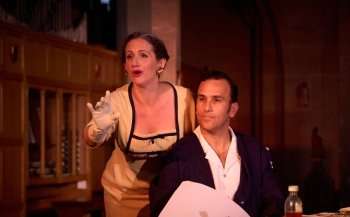
I don’t even know if this even counts as opera. This is not to be snobbish or elitist at works that challenge the status quo, but there was so much spoken word in this show that I started to think this show had similarities to musical theatre, in that people would converse at length, and then at some point, a character’s emotions would run so high (or indeed deep) that they could not help but burst into song. As the evening dragged on (and it did drag on), however, it started to become, in effect, a play with songs. It did, at least, mercifully spare the audience the operatic convention of someone singing for a quarter of an hour after getting knifed. But Harry Gentry’s Angelotti was slain so suddenly there wasn’t even a cry of anguish. It was as if he were shot dead.
Apparently set in South America, there was nothing in the way of set, costumes or indeed accents to indicate this – there’s a reference to Tosca (Anna Sideris) having negotiated for her and her lover Cavaradossi (Anthony Flaum) to get a boat out of the Port of Montevideo, but that’s about it. They sang about going away forever, in a song that itself seemed to go on forever. Perhaps surprisingly for a modern adaptation of anything, the Church is portrayed somewhat positively. The opening scenes include, amongst other things, fond memories of parishioners attending confession and then receiving absolution. Later, it rejects Scarpia (Brendan Collins) for ordination into the priesthood, as his views are too extreme, which does at least give the Church some credibility, whilst also explaining his rather sudden rise to the top of the Secretariat of State Intelligence, and a classic case of, to quote Lord Acton, “absolute power corrupts absolutely”.
Hard-hitting in more ways than one, the show demonstrates some boldness when it comes to its portrayal of Scarpia’s dictatorial rule, or the terrorism of a nation, to slightly misquote the libretto. It is a reminder of what the future might hold in a world seemingly increasingly prone to riotous and disorderly public behaviour, whatever the underlying causes may or may not be. I wonder if there was too much in the way of exposition – the show’s spoken dialogue, extensive as it is, explains everything, and the programme also has a synopsis (in tiny font, in white lettering against a black background – I struggled to read it even on the way home, sat on the Tube, with bright fluorescent strip lighting). There were some opportunities for the cast to show their operatic voices, particularly for protagonist Tosca and antagonist Scarpia, but none of the songs took my breath away. It’s all very well being able to understand a show, but this shouldn’t be at the expense of enjoying it.

Review by Chris Omaweng
Catholicism and the appeal of dictatorship are never far from the surface in Puccini’s Tosca. Can revolution or religion change human nature? Can art be the agent of either, or does it merely passively record the process?
Becoming Tosca, a unique and innovative lyric drama, relocates the action to an unspecific Latin American setting in the second half of the 20th century; a nation founded on Jesuit colonisation, where religion now jostles with the politics of capitalism and self-interest. It is a society dominated by the struggle to exchange poverty for influence, still seeking solutions to all-pervasive inequalities and oppressions. Does the church love repentance, or does it prefer punishment? Is brutality a necessary weapon to control a turbulent population?
Even now, we do not have answers and until we do, these questions must continue to be examined.
Combining newly commissioned music with an abridged version of Puccini’s sumptuous score, Becoming Tosca challenges the preconception of the original and the artform of opera itself.
Anna Sideris – Tosca
Brendan Collins – Scarpia
Anthony Flaum – Cavaradossi
Jonathan Cooke – Spoletta
Harry Gentry – Angelotti
Christopher Cowell – Original Director, Dialogue and New Writing
Frank Moon – New Musical Compositions
Lesley Anne Sammons – Original Musical Director
Viva Halton-Wright – Original Designer
Rebecca Marine – Revival Director
Berrak Dyer – Revival Musical Director
Giacomo Puccini – Original Composer
Boyan Ivanov – Clarinet Solo/Promenade Musician
GRIMEBORN OPERA: BECOMING TOSCA
Arcola Theatre
2 to 6 September 2025

