A traverse stage, or ‘alley’, ‘corridor’ or ‘catwalk’, is in use in a reconfigured Dorfman Theatre, though I’m not convinced it made much difference to this show, and if anything, made things more complicated than they needed to be. Berlin in the aftermath of the Second World War was divided into four sectors and administered by the UK, the USA, France and the USSR, with a ‘United Nations Relief and Rehabilitation’ centre, run by Ruth (Juliet Stevenson), a multilingual Briton. The centre was in the American sector, not that this stopped the Russians barging in at some point and insisting that what they say goes and there is nobody who can tell them otherwise. Except, of course, at the time, there was nothing quite like an American pushback, and elsewhere, it is Ruth who finds herself desperately calling for restraint when the US military wants to administer their version of justice on someone, with a gun (of course).
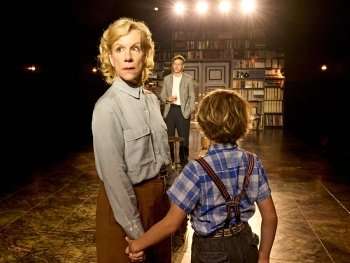
Thomas (Tom Wlaschiha), who turns out not to be called Thomas – but I shall keep faith with the list of characters as given in the show’s programme – decides to visit Ruth decades later, and so this is a show that can be added to the ever-growing list of plays that time-hops between generations: boing, boing, boing. In 1945, Thomas was ten, and Ruth was twenty, and if you are so inclined to work out what their respective ages would have been in 1990, feel free. A younger version of Thomas (on press night, Artie Wilkinson-Hunt: the role is shared with Platon Filatov, Darcy Tosun and Anton Vehring) is suitably boisterous and excitable – and often prone to anger and frustration, is taken to the centre, despite having guardians (Mark Oravec and Cosima Shaw) who weren’t in the business of abusing him in any way, as far as one could deduce.
The problem was that his adoptive parents were given Thomas by the Third Reich, who had literally kidnapped him, as well as plenty of others, from Poland and other Eastern European countries. Still, Ruth’s mother (a highly convincing Caroline Loncq) has a point when she questions the logic of removing children who already have a roof over their heads, given finite resources. Ruth, of course, has her reasons for continuing with her mission
A considerable amount of time was given over to pondering what the ‘right’ course of action ought to have been. Perhaps unsurprisingly, older Thomas is unhappy with what happened, at least partly because Ruth had made different arrangements for young Thomas, which no other child in the centre was either treated or subjected to. The whys and wherefores are never fully explored, which seems odd in a play that is at least twenty minutes too long and could do with the pace and sense of urgency throughout that was on display when an evacuation was underway.
The traverse staging felt like watching a tennis match at the Wimbledon Championships, with some audience patrons craning their necks back and forth to look at whoever was speaking. True, nobody forced them to do that, but the alternative would have been to treat the show like a radio play, and there wasn’t a sufficient level of description to have made that feasible.
Translation of dialogue in German, Polish and other foreign languages was sporadic, and occasionally, quite a few lines simply had to be disregarded, at least by me. On the other hand, when Ruth tells Young Thomas she and her staff will communicate with him “only [in] Polish”, it would have been better if they actually did so! In other scenes, there were some questionable American and German accents (let’s be charitable and not name names) in what was an uneven and sluggishly paced production, even if it’s a worthy choice of topic at a time when migration is a pertinent contemporary issue.

Review by Chris Omaweng
Germany, 1945. Thomas, one of thousands of children stolen by the Nazis from Eastern Europe during WWII, is under the care of Ruth, a UN relief worker. Should she try to find his parents or leave him with those he’s grown up with? The choice she makes will shape his life.
London,1990. Years later, Thomas visits Ruth. As they untangle the past, the decisions Ruth made as a very young woman are called powerfully into question.
CAST – in alphabetical order
Mayor – Atilla Akinici
Dora – Kate Duchêne
George – Michael Fox
Pawel – Hubert Hanowicz
Elise – Caroline Loncq
Olga – Avital Lvova
Bill – Michael Marcus
Theresa – Anastasia Martin
Thomas’ Father – Mark Oravec
Thomas’ Mother – Cosima Shaw
Ruth – Juliet Stevenson
Anna – Sasha Syzonenko
Thomas – Tom Wlaschiha
Young Thomas – Platon Filatov / Darcy Tosun / Anton Vehring / Artie Wilkinson-Hunt
Children’s Voices – Nelly Adeyemi, Amelie Dokubo, Platon Filatov, Maxence George Lippe, Eos Groen, Jan Hulboj, Eliska Hummel, Tim Jupiter, Matyla Kasczyszyn and Solomiia Parubok
CREATIVES
Director – Stephen Daldry
Set Designer – Miriam Buether
Costume Designer – Nicky Gillibrand
Lighting Designer – James Farncombe
Sound Designer – Gareth Fry
Composer – Paul Englishby
Movement Director – Paul McGill
Fight and Intimacy Director – Maisie Carter
Casting – Naomi Downham
Voice Coach – Cathleen McCarron
Language and Dialect Coach – Victoria Woodward
Associate Director – Jane Moriarty
Staff Director – Julia Leval
THE LAND OF THE LIVING
A new play by David Lan
Dorfman Theatre, National Theatre, South Bank, London
9 September to 1 November 2025

