The Dying Wish, written by Mauro Fazion and directed by Verônica Sarno, promises to pack a lot into just over an hour.
We are promised a satirical, absurdist comedy, which seeks to explore many dark themes, including injustice, the ethics of capital punishment, the inherent contradictions of the legal system, the balancing act between duty and cruelty, and the patent ridiculousness of applying legal norms, processes and procedures to their ultimate, insane conclusion.
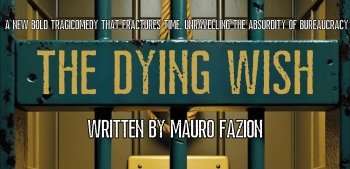
Set in a crumbling execution chamber, the play follows two hangmen, Rooney and Ingmar, as they attempt to carry out the state-sanctioned execution of Paul Freeman, a man condemned for an escalating list of bizarre and increasingly nonsensical “crimes.” As a new execution method is presented and tested, with the condemned man standing awkwardly and mutely to one side, unexpected visitors gatecrash the execution chamber, whilst the increasingly bizarre and narcissistic defence lawyer enters the action periodically, frenetically muddying the waters by claiming success in reducing some of the alleged capital crimes against the accused, whilst adding additional ludicrous fresh indictments to a list which makes the end result a tragic foregone conclusion.
Confused? This is a play that demands the full attention of the audience to keep up with the rapidly escalating layers of absurdity that are thrown at them.
As the audience enter the auditorium, the stage is abuzz with activity. A white-coated technician is fiddling with a newly installed electric chair. A noose hanging up at the back and alarming notices affixed around the walls leave no doubt that we are entering an execution chamber, which raises intriguing questions about whether we, as audience members, are complicit in the grotesque spectacle about to play out in front of us. Two executioners, bedecked in black, are chatting desultorily whilst a sharp-suited, clipboard-carrying lawyer prowls around the stage.
The entry of the condemned man adds an uncomfortable element to the progression of the narrative. He stands mutely to one side, watching with an increasing sense of despair and alarm as the devices intended to end his life are tested in front of him, and is forced to listen to the discussions between the executioners of “humanising the process”, and “rolling out new procedures” for judicial killing.
As the plot advances, the piece spirals into ever-increasing levels of farcical absurdity, with breathless expositions of moral incongruity, discourses on the nature of guilt, punishment, and connivance in legalistic retribution.
Levels of surrealism are enthusiastically cranked up, whether that be the sudden appearance of the condemned man’s mother, handing out cakes from a picnic basket, or the arrival of his daughter, who is frantically trying to cope with their drug addiction.
The Dying Wish of the play’s title is revealed to us as the desire of the condemned man to play the piano one last time, his attempts to do so interrupted three times by the arrival of the extraordinary defence lawyer, whose grasp of reason becomes as confused and dishevelled as his clothing.
The cast attacked the relentless complications of the narrative with enthusiasm and pace, and there were some good performances.
Omar Aga and Chris Gallagher, as the world-weary and cynical executioners Rooney and Ingmar, offered some interesting observations on the nature of the practices and processes of capital punishment, and were especially strong on their wrestling with the moralistic implications of their chosen profession.
Particular praise must be given to Chris Marachi, as the condemned Paul Freeman.
Marachi’s portrayal of the only sane individual in the madhouse, and the thoughtful, compassionate dignity he brought to the role, was quietly powerful and effective. His final speech about the nature of courage, both physical and moral, was the highlight of the entire piece.
The Dying Wish is an incredibly ambitious piece. There are many complex issues raised, in a number of theatrical formats, in just over one frenetic hour.
Part dystopian nightmare, part highly energetic farcical black comedy suffused with healthy doses of Kafkaesque diversions and Orwellian tangents, with more than a nod to some of the darker elements of Brecht and Ionescu, this production seeks to cover so many angles that it falls into the difficulty of trying to get a quart into a pint pot and, in so doing, blunts the edges of its critical thrust.
This intrinsic lack of determinative clarity, and a fundamental inability to decide exactly which points to concentrate on driving home, constricts the narrative flow. As the plot develops, the impression is given of huge numbers of ideas and situations being thrown at a wall, hoping that they stick. Some do; some do not.
Writer Mauro Fazion, in discussing the play, said, “The Dying Wish doesn’t advocate for any specific ‘message’ and has no intention of spreading any particular idea. I don’t write with a pre-determined message in my head, or an idea to ‘get across’ to the audience.”
Therein lies the difficulty for this production. However adept the absurdist dialogue, the surreal scenarios, the dark comedic episodes, and occasional clownesque theatricality, the central message of this play is obscured by the plethora of its themes and blunted by the multiplicity of its approach.
Ambitious? Yes. Satisfying? Unfortunately, not quite.

Review by Johnny Oxford
Set in a crumbling execution chamber, The Dying Wish follows two weary hangmen, Rooney and Ingmar, as they attempt to carry out the execution of Paul Freeman, a man condemned for an escalating list of bizarre and increasingly nonsensical crimes that say more about the broken system than the man himself.
As a new execution method is presented, unexpected visitors arrive and the list of charges grows more surreal, the piece spirals into absurdity, dehumanisation, and moral ambiguity, confronting audiences with the contradictions of institutional violence and our collective moral blindness. The line between duty and cruelty blurs, forcing both the hangmen and the audience to confront the very nature of guilt, punishment and complicity.
Cast: Chris Machari, Omar Aga, Chris Gallagher, Precious Scott, Romeo Olukotun, Cyril Auclair, Andrea Furlotti and Iago Cabrero
Director/Producer – Verônica Sarno
Writer/Co-Producer – Mauro Fazion
Stage Manager/Producer – Claire-Monique Martin
Fractured Time Products presents
THE DYING WISH
Golden Goose Theatre, 30 September and 1 October 2025
Presented as part of The Lambeth Fringe

