It’s now getting to that time of year when Halloween creeps up on us like a ghost in the night. This is a time when ghost stories become very popular for both stage and screen. Susan Hill’s 1983 classic, The Woman in Black, is a perfect ghostly, gothic delight when it comes to Halloween, as it returns to the stage once more on its current tour. Thanks to adapter Stephen Mallatratt, this haunting stage version brought the original text to light and created an intense, yet intriguing atmosphere to the proceedings.
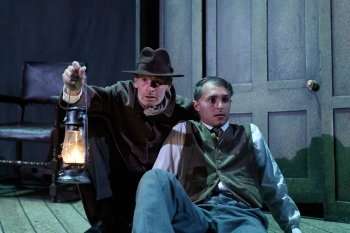
London’s Alexandra Palace Theatre seemed very apt for this story to be held here, as many of the original features are still there today. Even as you walked into the theatre, a ghostly presence was felt just from the stage alone. It was set with drapes of torn dust cloths, a slanted stage, a single chest where many props and costumes resided and the rest was a simple, open stage with a gauze backdrop and many adaptable sets.
Is it all really as it seems? This was the leaping point that The Woman In Black began to explore from the word go as a solitary figure entered in complete silence.
John Mackay played this solitary man, Mr Kipps, who hired an actor to help him tell his story. To get it out in the open for a presentation for his latest book launch. But it all seemed too real to be just a simple ghost story as it all developed. He had a sense of nervousness about him that had a certain charm, as well as intrigue. Mackay’s mannerisms displayed a sense of urgency, drawing us into his plight as he tentatively told his story with the aid of the actor, played by Daniel Burke. In contrast, Burke’s actor displayed a sense of ownership as he took centre stage, as well as relished the opportunity to not only get stuck into the story, but in a directly honest way, got Mr Kipps to get straight to the heart of the book and strip it down to the heart of all that was to come. Both men worked together extremely well as they not only, through their respective characters, created an atmosphere that drew everybody in, but showed immense skill by taking on the other roles involved within this dark and ghostly tale with an ease that created a sense of uncertainty and more.
Combining the dynamic skills that these two had to offer, they created something that you don’t normally see on stage. The perfect blend of every genre of performance imaginable. Ranging from storytelling, comedy, physical theatre, suspense and drama, McKay and Burke gave us a master class in how a gothic tale should be portrayed. There was never a dull moment as they toyed with our emotions, played with our minds, making us question what we think we know, and making us jump in fright. Combined with some of the most well-timed and planned atmospheric lighting and sound ever created, what we saw was not just a play, but an unforgettable experience in how ghosts can really appear when we least expect them.
Is it all in the imagination? Or is it real? The Woman In Black will make you decide one way or another. Not to be missed!

Review by Sascha Cooper
Obsessed with a curse that he believes has been cast over him and his family by the spectre of a Woman in Black, Arthur Kipps engages a sceptical young actor to help him tell his terrifying story and exorcise the fear that grips his soul.
Daniel Burke – The Actor
John Mackay – Mr Kipps
Dominic Price – Understudy The Actor
Philip Stewart – Understudy Mr Kipps
Stephen Mallatratt – Playwright
Robin Herford – Director
Antony Eden – Associate Director
Michael Holt – Designer
Kevin Sleep – Lighting Designer
Sebastian Frost – Sound Designer
THE WOMAN IN BLACK
Alexandra Palace Theatre, 8 to 25 October 2025
Richmond Theatre, 25 to 29 November 2025
UK tour continues to 25 April 2026

The lighting was superb and the acting was excellent. However, the first 15 minutes of the script—where the lead kept insisting they weren’t an actor and didn’t want to perform—felt unnecessary and dragged on. It didn’t add to the story and made the opening a bit dull. That time could have been better used to build tension in the scarier moments, like the ruffled child’s room and the rocking chair.