One of the (many) joys of theatre are the new things which individual productions make one aware of. Good theatre can educate as well as entertain.
This is the notion at the heart of Lightning Beneath the Waves. It tells the story of the trials and tribulations involved in the successful laying of the first transatlantic telegraph cable in 1866, after over a decade of blood, sweat and tears; an event which has receded into the mists of history, but should be remembered as being a major contribution to the development of our instantaneously connected world.
In the first half of the 19th century, sending a message across the Atlantic took weeks. The ultimate triumph of surmounting all geophysical, engineering, financial and political obstacles to achieve the breakthrough of eventually delivering a methodology of communicating over vast stretches of the ocean changed everything.
This breakthrough allowed for near-instantaneous communication between continents, accelerating economic, political, and cultural integration. The eventual success of this hugely ambitious project marked a pivotal milestone in global telecommunication networks, proving that electrical signals could be transmitted over extensive, far-flung distances across the most challenging of terrain and vast oceanic distances.
The groundwork laid by these early cables evolved into today’s intricate web of fibre-optic cables, enabling high-speed data transmission and the modern internet’s global reach. By shrinking the world through real-time communication, the engineering marvel that is the subject of this play ushered in a new era of interconnectedness and continues to shape our modern world.
In addition to the technological marvels, we become witnesses to the vision, determination and sheer bloody minded commitment of the key players in the realisation of such a feat; Frederick Gisbourne, who had the original idea of linking continents via indestructible telegraphic cables; Cyrus West Field, the self-made entrepreneur who saw the potential in Gisbourne’s concept and championed it financially and politically, providing critical and moral support after early failures threatened to derail the entire project. Finally, we have the stovepipe-hatted engineering genius Isambard Kingdom Brunel, whose steamship, “The Great Eastern”, (then the largest ship afloat), after a series of heartbreaking setbacks, eventually triumphantly crossed the Atlantic, and laid the much-promised and much-anticipated communications cable. The Transatlantic link was finally established. The inaugural message was transmitted in August 1866 from Queen Victoria to US President Andrew Johnson, and the rest is history.
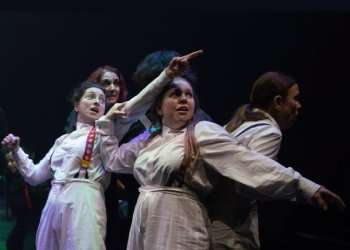
Questors, under the direction of David Horvatter, have taken an inventive and imaginative approach to the telling of this tale. Through a devised melange of physical theatre, live music, original songs and conventional drama, we are taken on a journey through this much-neglected piece of history.
The ten-strong ensemble cast, alternatively clad in black and white (Brunel is portrayed outside this grouping), take on a series of physical roles to evoke everything from the vastness and power of the Atlantic Ocean, the huge bulk and grinding dynamism of steamships, groups of cynical business investors and even the telegraphic cable itself.
This is done effectively and ingeniously, and it is clear that the group have been well drilled, knows where they should be at all times and moves as a coherent whole to depict the various images and representations of the key parts of the story. Particularly effective was their excellently choreographed, coordinated swaying and rocking to portray the boundless, immense energy of the sea.
There was a fluidity to their movement and positioning, which helped the core narrative to progress effectively.
Flashes of humour were also present, especially in their depiction of hard-nosed businessmen and politicians, puffing on their ever-present imaginary cigars, and the swift commercialisation of the successful cable laying, with opportunists quickly offering cable jewellery, cable perfume and cable chocolates to the public. Knowing dialogue about the fundamental importance of London to the ongoing health and prosperity of the US economy and the confident, idealistic assertion that “When the cable comes, there will be no war,” brought about some sardonic laughter from the 21st-century audience.
In addition to the ensemble playing, there were some strong individual performances. Craig Nightingale gave us a Cyrus Field whose determination and perceptiveness provided the focus of the narrative. Marcus Boel’s obsessive visionary Frederick Gisbourne possessed a particularly fine singing voice, whilst Jerome Joseph Kennedy gave us a Brunel whose egotistical asceticism underpinned his genuine pride in his engineering achievements.
The four-piece band complemented the action with appropriate playing and well-executed aural effects, particularly the perfectly timed percussion accompaniment, effectively emphasising the striking of hammers as the cable is laid and secured.
Whilst there is much to enjoy in this innovative production, there are improvements that would enhance its overall flow and structure. The overall show could be shorter, punchier and, arguably needs no interval.
There is a lot of information, some of it necessarily technical, which is included in the plot that gives some parts of the dialogue a top-heavy feel and is not completely germane to the development of the narrative; for example, the role played by Samuel Morse in the progress of communication technology and some of the information surrounding The Great Eastern’s ultimate fate.
Similarly, whilst a lot of the accompanying music and songs were pertinent and enjoyable (for instance, the gospel number which accompanied the original pitch of the idea by Gisbourne to Field), some others felt a little shoehorned into the action and held up the flow of the storyline. The final number, which occurred after the bow had been taken, seemed an unnecessary coda.
No doubt, as the run progresses and the ensemble relaxes into the piece, confidence will grow, pace will increase, and enunciation will become clearer (with projection an occasional challenge in some of the musical numbers and one-line dialogue delivery, especially as this play is performed in the semi-circle).
Future iterations of this production may well benefit from a little judicious cutting and possible excision of some musical numbers to bring the timing to around 80 minutes, thereby enabling it to be staged without an interval, which rather disrupted the fluidity and continuity of the piece.
That having been said, Questors are to be congratulated on their enthusiastic, imaginative and innovative approach to the recounting of a largely forgotten tale, without which our world would be a very different place.

Review by Johnny Oxford
The Transatlantic Telegraph Cable was not an overnight success. It took five attempts, twelve years, and an unwavering determination to succeed. American businessman Cyrus Field had that determination. Despite technical failures and personality clashes, Field was undaunted. He just needed the right equipment.
Enter Isambard Kingdom Brunel’s SS Great Eastern. The largest ship built at the time and originally intended as a passenger ship, Field had other ideas. Connecting Britain and America was his dream, and with Brunel’s Great Eastern, he could make it happen, at last.
Through physical theatre and live music, discover the two men whose iron wills shaped the way we communicate forever.
LIGHTNING BENEATH THE WAVES
The Questors Theatre
8 to 15 November 2025

