Blue Moon is the song that Manchester City fans have adopted as their club anthem. This song unlike Liverpool’s “You’ll Never Walk Alone”, celebrates being alone. “Blue moon, you saw me standing ALONE. Without a dream in my heart, without a love of my own.” Manchester City fans do in fact have a love of their own: MCFC. However, the writer of the titular song Lorenz Milton Hart (1895-1943) really was alone and unloved. The new film from Sony Picture Classics, Blue Moon, tells the story of his extraordinary life by focusing on one moment. It’s a sliding doors moment. Richard Rodgers dropped Hart and decided that Oscar Hammerstein II was the lyricist for him. And he was right of course because that partnership, Rodgers & Hammerstein, is the one which gave us Oklahoma, The Sound of Music, South Pacific, Carousel – which features “You’ll Never Walk Alone” – and The King and I. How did this happen and why?
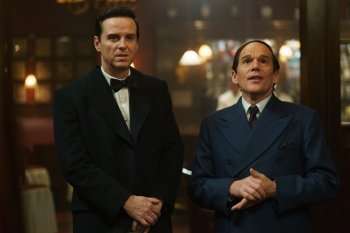
A diminutive, Jewish, homosexual, dipsomaniac with a death wish Lorenz Hart was a tortured genius. A confluence of the barbed wit of Truman Capote – another diminutive homosexual – the satirical invective of Joe Orton and the neurotic humour of Woody Allen, Lorenz Hart was the finest lyricist of his generation. His middle name was Milton and he certainly lived up to the English poet’s grandeur. As well as Blue Moon he wrote “Manhattan”, “The Lady is a Tramp”, “My Funny Valentine” and “Bewitched, Bothered and Bewildered”. The film is a non-stop monologue in which Ethan Hawke brings Hart vividly to life. Visually Hawke has Hart to a T. The comb over reminiscent of Rab C. Nesbitt, the small man with a big cigar, (almost as big as him, Freudian themes are ever present), the card tricks, all so many props to prop up a lost soul. The entire film takes place in Sardis restaurant in New York in 1942 one year before Hart’s death. It’s the after party for the opening night of Oklahoma. It proves to be a night of two catastrophic blows for Hart. He is crushed both professionally and personally.
The driving force of the film is Ethan Hawke’s monologue. A breathless stream of consciousness tour de force of jokes, anecdotes, stories, bon motes, puns, double entendres, asides and much more, (my favourite was “Rabinowitz has circumcised his name to Robbins to ingratiate himself with the WASPs”) the outcome is highly entertaining, shockingly disturbing and ultimately exhausting. This we realise is a man who can’t stop. To paraphrase Chas and Dave “he won’t stop talking, why don’t you give it a rest”. The combination of liquor and loquaciousness defined him. This gabby, garrulous, gay lyricist does everything in top gear. The monologue then is the films essence. I found it a double-edged sword. Sure, Hart is funny, transgressive and vulnerable and I empathised with him but there is only so much one can take of this monologic intensity. It’s like eating five crispy cream donuts one after the other. It’s just too much.
Having said that there are some scenes which break the manic monologue. Those with Richard Rodgers (Andrew Scott) are intriguing. Hart hasn’t twigged that Rodgers is pushing him aside for the more bankable and reliable Hammerstein. Scott gets just the right balance between stringing Hart along (promises of future work together) and letting him know that he’s not putting up with the drinking anymore. Scott is ambitious and knows that Hart is now an albatross around his neck. He is ruthless enough to cut him loose and go with the new kid on the block. Here we see one of Hart’s many flaws as a human being. He thinks friendship is for ever but for Rodgers it’s only ever a stepping stone to greater things. The same pattern plays out with Hart’s infatuation with the young student Elizabeth Weiland (Margaret Qualley). Showing a complete lack of self-knowledge Hart thinks she’s in love with him. There is no fool like an old fool and in this misreading, Hart sets himself up for a debacle as crushing as his separation from Rodgers. Lorenz Hart certainly had a big heart but tragically not a love of his own. What makes the film so poignant is the contrast between the lyricist who could write “Bewitched, Bothered and Bewildered” with its knowing insight into the agonies of love and the naivety, guileless and mangenue behaviour of the man in real life. Blue Moon has demonstrated yet again that there is a world of difference between the art and the artist. D H Lawrence got it right: “Trust the tale not the teller.” We could adapt that and say of Hart trust the lyrics not the lyricist. Like so many tortured souls he turned to the demon drink to fill the void and ended up drinking himself to death. Blue Moon does a fine job of telling Hart’s story with clarity, concision and compassion.

Review by John O’Brien
On the evening of March 31, 1943, legendary lyricist Lorenz Hart confronts his shattered self-confidence in Sardi’s bar as his former collaborator Richard Rodgers celebrates the opening night of his ground-breaking hit musical Oklahoma!.
Ethan Hawke – Lorenz Hart
Margaret Qualley – Elizabeth Weiland
Bobby Cannavle – Eddie
Andrew Scott – Richard Rodgers
Jonah Lees – Morty Rifkin
Simon Delaney – Oscar Hammerstein II
Cillian Sullivan – Stephen Sondheim
Patrick Kennedy – E. B. White
John Doran – Weegee
Anne Brogan – Frieda Hart
David Rawle – George Roy Hill
Robert Kaplow – Writer
Richard Linklater – Director
BLUE MOON
In selected cinemas from 28 November 2025

