There is nothing new about Hollywood scandals.
From the very beginning of filmmaking, the actors, directors, production crews, writers and all other creative workers producing movies have loved, lost, and partied to excess, avidly pursuing what, to more traditionally inclined observers, might appear to be bohemian hedonism writ large.
Behind the glitz and the glamour, there has always been a very dark side.
A number of major sex and murder scandals rocked the early years of filmmaking. Many will be aware of the furore surrounding the trial of huge star Roscoe “Fatty” Arbuckle, who, despite being eventually acquitted of the rape and manslaughter of model and actor Virginia Rappe, was ostracised and his hitherto stellar career crushed under a welter of opprobrium and dishonour. Similarly, silent film comedy legend Thelma Todd’s mysterious death in a parked, locked car remains unexplained and has been the subject of books and documentaries.
A little less well-known is the unsolved 1922 murder of the highly influential silent film actor, producer and director William Desmond Taylor. Taylor was found dead in his Los Angeles home. The cause of death was eventually determined to be a gunshot wound to the back, though the murderer was never found. The murder caused a media frenzy, as the public speculated about who was responsible for the killing.
Writers Julie Balloo and Donna King’s play The Paper Doll House focuses on the enduring aftermath of this case, viewing it through the prism of the lives of the main two suspects in the case, Mary Miles Minter, a then underage child actor with whom Taylor had had a tumultuous sexual relationship; and Minter’s mother, Charlotte Shelby, a controlling and manipulative stage actor mother who was accused of living out her own dreams of stardom through her daughter. Indeed, Shelby’s other daughter, Margaret Shelby, accused her mother of being the murderer, as did many of the nation’s newspapers.
When newspapers reprinted the numerous explicit and passionate love letters Mary had written to Taylor, her reputation and career were ruined.
Fast forward to one night in 1956, in a shabby, faded apartment where the ageing and bitter Charlotte Shelby is watching the popular TV game show I’ve Got a Secret when the doorbell rings…
Enter Betty, an Avon Lady, later followed by her volatile partner, Eddy, who purportedly works in TV and has identified Selby and Minter as potential subjects for a TV show about their past, tantalisingly offering them a second chance at fame and potential rehabilitation, but at what cost?
With both sides seeking to profit from the other via the proposed show, we are catapulted into a compelling power struggle, both within and without the two pairs, Charlotte and Mary, and Betty and Eddy.
The writers, together with director Tug J Wilson, have immersed themselves in the detail of this case and created a piece which is influenced by Sunset Boulevard, with more than a hint of Whatever Happened to Baby Jane in the more caustic dialogue between mother and daughter.
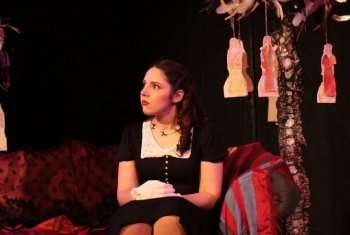
The intimate ambience of the Old Red Lion Theatre is perfect in framing the shabby, dilapidated apartment in which the action takes place, and propelling the audience into the very centre of the action, where every facial expression, every flashing glance, every sneer and every grimace is minutely delivered.
There are many enjoyable references to the culture of the era of film and stage production as Selby and Minter reflect on their nostalgia for the films, shows and actors with whom they have worked. In a stylish film noir opener, a gumshoe private detective, redolent of the period, briefly sets out the history of events, ensuring that the story is accessible for those less familiar with the period, and closes the piece, asking the audience to make up their own mind about the veracity of the tale that they have just seen.
In such an intimate environment, where the whites of the actor’s eyes are always visible, it is important that the ensemble playing is of the highest order. Here, we are in very safe hands, with excellent, believable characterisations displayed throughout.
Jan Goodman, as Charlotte, gives us the epitome of faded grandeur and a whiff of threadbare glamour, effectively exhibiting her inability to free herself entirely from the hopes of a second chance at fame via the new medium of TV. Despite her acidic put-downs and caustic irony, her ultimate loyalty to, and love for, her daughter, with whom she had once invested so much hope, comes through, especially in her rather ambiguous final assertion that she always knew that Mary was innocent of Taylor’s murder.
Carol Been’s Mary suffers from no such illusion of the possibility of a second bite of fame. With her tatty white gown, cascade of long hair, and abrasive manner, she brings to mind a worldly, drink-sodden Mary Pickford, intermingled with more than a hint of Miss Haversham. She is contemptuous of Eddy’s blandishments, seeing him for what he is, but develops a touching empathy with Betty, in whom she recognises a long-lost version of herself. Mary realises the futility of tilting at the windmill of fame and is scathing of her mother’s destructive obsession with getting one more chance of acclaim and recognition.
Chloe Teresa Wilson’s Betty avoids the cliches of the portrayal of a young ingenue to deliver a moving portrayal of an ambitious, wide-eyed wannabee desperate to get “the break” and become a legitimate star like her heroine Marilyn Monroe. When required, she has great comic timing. Her breathless romp through the various lotions, lipsticks and fragrances on offer from the Avon catalogue is amusing and perfectly pitched. Conversely, her inability to break free completely from her abusive partner Eddy is moving and deftly nuanced.
Tom Inman’s Eddy is an unprincipled grifter who is prone to anger and violence. His striking of Betty is shocking, a sudden dash of freezing water cutting through some of the sardonic sallies about the nature of fame and ambition which pepper the narrative. A strong and unsettling performance.
The juxtaposition between the ambitions and hopes of two generations, each searching for fame and validation, is well pointed, and the intersection of their characterisations delivers a narrative that always remains compelling and poignant.
At its heart, The Paper Doll House is a tale of the pursuit of, and attempt to rediscover, fame; powered by an ambition that explores the wafer-thin connections between stardom, notoriety, obscurity and truth. It shines an uncompromising light upon the underside of the ostentatious glitz and pretentious glamour of the “Hooray for Hollywood” mantra, reminding us that, underneath it all, there is always a human price to pay.

Review by Johnny Oxford
When the doorbell rings at a crumbling Hollywood mansion in 1956, we witness first hand the tumultuous relationship between a suffocating stage mother and her silent film star daughter, Mary Miles Minter.
Mary Miles Minter, a former silent film star, and her mother, Charlotte Shelby, a former stage actress and lifelong stage mother, could never shake the suspicion that they were responsible for William Desmond Taylor’s murder. This remains an unsolved murder to this day; rumours circulated, but no one was ever brought to justice, and the scandal has followed them ever since.
Written by Julie Balloo
Additional Material from Donna King
Directed by Tug J Wilson
THE PAPER DOLL HOUSE
Old Red Lion Theatre
11 to 14 February 2026

