Writer Dexter Harding’s Set Menu is an inventive play brimming with complicated ideas. It begins while the audience is still being seated in the intimate, three-quarter-round space of The Cockpit Theatre in Marylebone, London. A glowing central light shines down on an oblong dinner table set for five (lighting design, Justine Regan). Only four of the five dining chairs have seat cushions. A refrigerator displaying a large numeric poster and a small stove are situated against the back wall of the stage. Front and stage right is a collection of objects: a small chess set, alarm clock, letter pouch and boombox (production design, Lydia Durnall). As the play progresses, the number on the poster changes repeatedly – it becomes a strong visual, almost a scene-stealer, if one can attribute such a description to an inanimate object (graphic design, Oli Silverman).
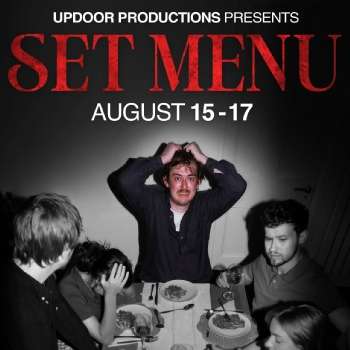
The theatre lights still haven’t dimmed as Max (Dexter Harding), a seemingly fastidious host, circles the dining table, concentrating on the arrangement of dinnerware, cutlery and gleaming wine glasses; he makes small adjustments to ensure the setting is perfect. Suddenly, the theatre goes dark. When the lights come back up, Max is switching on the boombox. A recording plays the voices of four dinner guests as they arrive: a married couple, Mark (Oli Silverman) and his wife, Ellen (Eleanor Hart); genial friend Siobhan (Amy Kennedy); and complicated friend MichaelAngelo (John-Jack Williams). Max responds to each recorded voice as if the speaker were actually present, with phrases such as: “Sorry we’re late, Max.” “Oh, no bother. Can I take your coats?”
So that’s it, you think to yourself. Max is a man with imaginary friends who is holding a dinner party with imaginary guests. And then Set Menu delivers its most effective surprise. One by one, the four dinner guests actually arrive, each speaking the exact words we’ve heard them speak on the recording. Max responds to each of them with the same words he used previously when addressing their recorded voices.
The guests take their places at the dinner table, and much wine is drunk, which leads to revealing but confusing hints as to who they really are. Like a punctuation point to end each scene, Max rips the numeric poster off the refrigerator door, only to reveal another poster with a greater numeric value beneath it. Then the scene repeats itself, always beginning with each guest’s entrance and ending with some mishap at the dinner table.
In each new scene, Max refills the wine glasses, his guests become less inhibited, and their drunkenness gives voice to expressions of violence: the happily married couple – will they maim or murder each other? Max and MichaelAngelo – what’s their modus operandi? And why does Max admit to spiking drinks with rat poison?
More intrigue and red herrings follow, but rather than enhance the play, there are too many to take in, especially concerning the relationship between Max and MichaelAngelo. Are they throwbacks to a dark and sinister era – think Dr Faustus and Mephistopheles – or are their characters representatives of guilt and regret? Finally, and quite humorously, the refrigerator becomes a sixth character – but you’ll have to see the play to understand it.
Set Menu is a difficult undertaking, but director Cara Crozier-Cole handles the task admirably, especially in regard to the rhythmic flow of dialogue within each re-enacted scene. Its actors, who face similar challenges, dig deep and create real characters beneath the play’s comedic surface. Writer/actor Dexter Harding writes with much sophistication and humour, but despite its many strengths, its characters introduce too many ideas which seem unrelated to its final disclosure. This is not a drawback; it’s the value of debuting a play on the Fringe and then, following its preview, considering what changes might be beneficial. As a play brimming with humour and invention, Set Menu is definitely worth the price of a ticket.

Review by Loretta Monaco
Friday night. Food is ready, drinks are cold, cutlery is set. Max is primed to throw the perfect dinner party. Nothing but perfection will do; nothing else has worked. After a hundred attempts, he knows exactly what to do and say.
Hours later, the guests leave satisfied, as Max waits for the clock to set him free. This time for sure, he’s earned a tomorrow. Set Menu begins 600 days later. Max has failed to escape so many times that he’s lost all sense of time and himself.
The clock resets, the guests forget, and he begins again.
One particularly awful night, he decides to reset the night early. When he wakes to try again, something’s different. He’s lost a pen. The plan? Simple. Chaos. He’s going to beat whatever is keeping him trapped by making the worst dinner party ever. With exceptional knowledge of the house’s contents and the guests’ psyches, he’ll take on the role of a twisted puppeteer. The food is burnt, the drinks are spiked, the cutlery is sharpened.
As anarchy reaches its peak, Max is confronted with a terrifying truth: one guest was never supposed to be there. And knows more than they let on.
SET MENU
The Cockpit, 15 to 17 August 2026
Presented as part of The Camden Fringe

