At some time or other, most of us will have experienced a social occasion which rapidly degenerated into arguments, veiled (or direct) insults and emotional anguish. In short, a so-called Dinner Party from Hell.
However much we may have suffered such an evening, it is extremely doubtful that any of us will have experienced a cataclysmically awful time than that experienced by Val and her boyfriend Hugh, who, as the play begins, are nervously awaiting the arrival of Val’s friend Nell, a relationship between the two women which is intimated from the start to be not entirely wholesome and relaxing. Yet, it is just going to be one evening. How unbearable, insufferable and harmfully disruptive could one guest possibly be?
The answer soon becomes pretty obvious. Very.
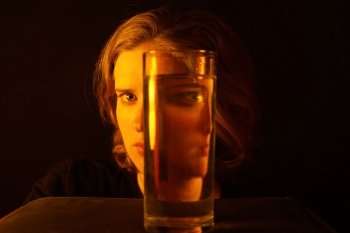
From the moment Nell bursts into the apartment, everything appears unbalanced and awry. Nell is hugely intense, immediately launching into vivid details about her (real or perceived?) health issues, declaring that everyone should drink twenty-five glasses of water a day, and immediately practicing what she preaches, downing five glasses in quick succession.
Nell moves wildly and fiercely from topic to topic, each invested in an escalating level of intensity, before she homes in on a series of episodes and characters from Val’s past which invokes a very real sense of growing uneasiness and anxiety in our hostess, clearly deeply uncomfortable with Nell’s bull-in- a- china shop unfiltered reminiscences, that culminates in an accusation of a shocking past incident of teenage violence.
Nell’s brutally expressed confrontational litany of these past experiences and emotional responses seems designed to, first, unravel and then destroy Val and Hugh’s carefully constructed sense of peace and togetherness, creating and exacerbating cracks in the faultlines and hitherto hidden insecurities of their relationship.
A sudden emotional gear change then occurs. In recounting the story of an encounter with a man and his dog at a bus stop, which soon escalates into gory, graphic and visceral violence, Nell moves from the bitterly corrosive and caustic agent of discomfort and restless foreboding to a deeply vulnerable, mentally disturbed and unsure young woman filled with a sense of haphazardly directed self-loathing.
This ambiguity lies at the heart of this work. Is Nell evil, mad or merely elaborately and skilfully playing mental charades to bring about a reaction from Val, and reset their difficult emotional connection?
And what is the true meaning of the dreamlike conclusion of the play, where we experience a deeply surreal recreation of some of the confrontational elements of the narrative?
Clare Stenning gets her teeth into her characterisation of Nell with undisguised relish and much skill. She moves effortlessly from provocative, in-your-face, irresponsible declamatory rants and assertions through a curious and disturbing insidious seductive wheedling and whining to a vulnerability shot through with doubt, fear and anxiety.
Samantha Begeman’s Val is similarly shot through with apprehension and repressed dread about her reconnection with Nell. She adroitly manoeuvres her own character change from initial unease and dismay to a more confident composure, as she seeks to somehow reconcile the madness which is playing out before her with a genuine concern for her friend’s mental state underpinned with her own recognition that some things are better left unsaid, and acknowledging that her lack of truth and honesty with Hugh may well threaten her hopes of an enduring future with him.
Jad Seyegh’s Hugh offers an often-amusing personification of discombobulation as he struggles to balance his incredulity with what is happening, to what the consequences of these actions might hold for him. Initially, the polite host is not immune from being deeply affected by the singular nature of how the evening is progressing. He speaks for many in the audience when, at one point in the narrative exclaiming rather desperately, “Give me something real.”
A word of praise here, too, for cellist Amelia Callard. On stage throughout but never intrusive, Callard’s music provides definition and delineation to the play. Her playing, at times soothing, at times harsh and discordant, at times threatening, perfectly matches the growing and intensifying tension of the piece. A perfect supplement to the action.
A Brief Play About Rage is billed as “… a chilly, absurd comedy of menace,” and there are certainly elements of both menace and comedy in it. Certainly, there is a strange magnetism in the piece which, despite being rather uncomfortable viewing and explicitly gross at times, encourages the audience to keep watching, not really knowing where we will go next, and how the play will end.
Yet, herein rests the fundamental flaw in the piece. Whilst the narrative seeks to point out the explosive consequences of the perpetuation of long hidden resentment and the smashing of unspoken belief systems, there is a sense of not knowing how to end everything.
Ambiguity is baked into the narrative but needs a degree of structure to deliver its points, and this is missing at the end of the action, with the denouement being muddied and unclear. This is a great irony when one considers that a key element of the play’s message is the importance of delivering home truths in a clear and unfiltered way. Even a surreal ending, which we are given here, needs an anchor point, a degree of definitive exactitude, to reinforce most effectively the issues made.
This is a production which contains a number of inventive ideas, has strong acting performances and good musicianship, yet lacks final clarity, cohesion and definition, and eventually sinks under the weight of its own contextual complexity.

Review by Johnny Oxford
It’s just one evening. How unbearable could a house guest possibly be?
Nell and Val have been friends for many years. Val has hated Nell for most of them, but has never had the courage to say anything.
When Nell comes to visit Val and her boyfriend Hugh in their apartment, she immediately asserts a brutal crusade of truth upon them, disrupting Val and Hugh’s carefully maintained peace and exposing parts of each other’s lives that they would rather keep hidden.
Val has never stated the deep resentment she feels towards Nell. Hugh and Val have never shared certain parts of themselves with each other. So what happens when someone finally says everything out loud?
Clare Stenning – Nell
Samantha Begeman – Val
Jad Sayegh – Hugh
Amelia Callard – Cellist
Deane McElree – Writer
Sophia Golan – Director
Bud Potter – Set/Costume
Francis De Lima – Light Design
A BRIEF PLAY ABOUT RAGE
Omnibus Theatre
28 April to 2 May 2026

