“Down this road on a summer’s day in 1944, the soldiers came. Nobody lives here now.”
These words, intoned with all due solemnity by Laurence Olivier, launched a 1973 landmark documentary series, The World at War, a hugely influential work which examined the origins, prosecution and aftermath of the Second World War. The very first episode began with helicopter views of the destroyed village of Oradour-sur-Glane. Images from the time are interspersed with the ruins as they are today, frozen in time, standing in mute remembrance of the events of June 10th, 1944 when 642 civilians, including non-combatant men, women, and children, were massacred by a German Waffen SS detachment as retribution for French Resistance activity.
The village was never rebuilt. President Charles de Gaulle ordered that its ruins be maintained as a permanent memorial and museum. It is still there.
The tragic history of Oradour- Sur- Glane is the pivot around which White Bear Productions offers an energetic and heart felt study of not only the story of a specific war-time atrocity, but also an examination of how history can reach out to the present day to affect our own 21st century lives, about how the past is always with us, and about how important it is to ensure that we remain vigilant to the inherent dangers of silence, apathy and complacency in creating the preconditions in which such horrors can happen again.
The story of All My Pretty Ones is told through the eyes of three young medical students, one German, Miriam, one French, Marie Christine and one Englishman, Steve. Heading to the South of France, a heavy storm leaves them stranded at the local train station late at night. With no accommodation available, the trio are rescued by a gentleman named Maurice, who, fortuitously for them (and the development of the plot!), owns a local guesthouse,…
Soon after their arrival, the discovery of an old diary, photographs and other war time memorabilia lead them into a historical detective story where they discover the tragic past of Oradour- sur- Glane, Not only do they unveil the dreadful reality of the massacre, but they also stumble upon shocking personal revelations which forces them all to confront concepts of inherited guilt, trauma, cultural silence, and the uncomfortable power of historical memory.
The narrative transports the audience between the current and the past, as the inhabitants of the former farmhouse where the students are staying are vividly brought back to life. We effortlessly move from 2025 to 1944 as the horror of Nazi occupation is played out on an idyllic French landscape.
There is a lot packed into this production, with its believability and success resting upon the strength of the ensemble playing. Here, there is a lot to commend.
The French children of 1944 Oradour, Claudine, Monique and Lucien, are very convincing. It is not easy to portray adolescence accurately, but all three actors rise effortlessly to the challenge, whether that be in the excitable interactions between them in early, teasing play, or in the frozen silence of fear that afflicts them when the Germans arrive to search the farmhouse, head bowed and clutching nervously at their clothes, toes pointed inwards.
The enigmatic guesthouse owner, Maurice, faces the particular challenge of having to impart significant levels of plot whilst maintaining interest in his character. He succeeds in this, skilfully dropping intriguing clues about his background and experiences into his narrative.
Transitions between the past and present are largely seamless and the narrative is a well-judged mixture of action scenarios and monologues, which enable each individual actor to break the fourth wall and explore their own motive forces and belief systems.
One scene that particularly stands out is the first appearance of the German soldiers searching for evidence of Resistance activity. The tension here is ratcheted up to an almost unbearable extent. A real highlight of the production is the superb characterisation of SS Major Diekmann by Greg Hobbs. His authoritative demeanour, suffused with softly spoken arrogance and hidden threat, together with his excellent use of German throughout, gave his character real depth and verisimilitude.
Bryony Tebbutt, as the matriarch Aurelie, portrayed her role as a woman balancing the love for her husband with her hopes for her beloved daughter Monique with great sensitivity. Her account of her final moments is both harrowing and moving, as was that of her husband, Pierre (Clement James).
This production used a band to provide live music to complement the narrative. This was largely successfully achieved. Perhaps they could have played appropriate music as the audience entered, which would have established the ambience from the start.
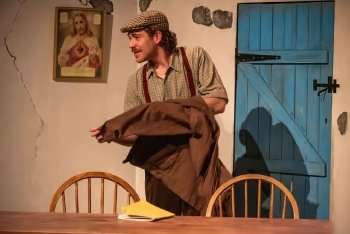
The set was simplistic and appropriate, with the kitchen table serving as the anchor point for the action in both the past and present, and lighting was used sparingly but effectively, especially in portraying the storm and the symbolic juxtaposition of a droning warplane whilst Monique’s future was being discussed by her parents.
The use of photographs of the actual topography and inhabitants of the real Oradour-sur-Glane, interspersed with those of the “1940s” cast, was also subliminally effective.
The real challenge of a production such as this lies in trying to avoid the problems of getting a quart into a pint pot. Not only do we have a strong narrative to follow, with much explanatory plot to impart, but there are also important observations to be made about the nature of war, memory and the demands that historical empathy makes of us.
This poses particular difficulties of length, with the need to tell clearly and in detail the story of a historical incident which is now not well known, necessitating a lot of time and effort. The first act was one hour and twenty minutes long, with the curtain not falling until 10:30pm. Was an 8:00pm start necessary?
Some judicious editing of scenes would have helped the narrative flow; for example, the help which Monique received from the German soldier, Hans, following her bicycle accident, establishing his credentials as a “good” German, could have been covered in a few sentences, rather than via a separate scene, without losing the impact and narrative importance of the incident.
Again, the initial setup of the students being stranded could have been moved along more swiftly to enable more time and space for the key moments of the narrative to develop.
It also must be noted that, for this reviewer, some of the coincidences of the relationships between the students and the characters of 1944 start to strain credibility, and the number of dénouements which came tumbling out at the end had the ring of a desire to wrap everything up too neatly and conveniently to provide a base for some of the final observations voiced by Maurice.
All My Pretty Ones is an ambitious project. It is so much more than a play about Nazi barbarism and historical truth. It seeks to shine a light on the enduring propensity of evil and the warning that we, in 2025, are not immune from the horrors of the past and its implications for the future.
The philosopher George Santayana once wrote, “Those who do not remember the past are condemned to repeat it.”
White Bear Productions are to be congratulated on their treatment of Santayana’s timeless observation and have delivered a production which demands to be seen.

Review by Johnny Oxford
Three young medical students, one German girl, Miriam, one French girl, Marie Christine and one British lad, Steve are travelling together to the south of France. However due to a heavy storm they become stranded at the local train station late at night. With no accommodation available, the trio are rescued by a gentleman named Maurice who owns a local guesthouse, and take up his kind offer of shelter.
Soon after arriving at Chez Maurice, the three students notice strange happenings, including the discovery of objects from the war, old photographs, as well as hearing music, songs and voices from the past. The audience is transported back to 1944 and the inhabitants of the former farmhouse are brought back to life.
The tragedy begins to unfold. The three young students embark on a journey where they discover the tragic past of Oradour sur Glane, the French village whose inhabitants were murdered by the Nazis on the 10th June 1944.
They not only discover what happened that fateful day in June 1944 but also stumble upon shocking personal revelations as they endeavour to find out the truth about the tragedy.
What’s On at Alexandra Theatre Birmingham
Katie Cannon as Marie Christine
Alice Orlik as Miriam
Talyaan Pambou as Steve
Andrew Cullum as Maurice
Bryony Tebbutt as Aurélie
Clement James as Pierre
Annaliese Morgan as Claudine
Leah Fennell as Monique
Amara Latchford as Lucien
Giles Whorton as Hans
Greg Hobbs as SS Officer
Presented by White Bear Productions
Written by Patrick Hayes
Directed by Marcus Fernando
Produced by Fateha Begum & Patrick Hayes
Executive Producer: Bella Hamblin
Music Composer: Jobe Sullivan
Stage Manager: Nathan Bowyer
Lights & Sound by Paul Withers
Costumes by Abeda Begum
Set Design by Angie Chapman
ALL MY PRETTY ONES
The Door, Birmingham Rep
14 to 17 May 2025

