Arcadia is not The Real Thing. Whilst the latter is indubitably Stoppard’s masterpiece, the former is overwritten, overwrought and overrated. It’s often said of a jazz session that the musicians are having more fun than the punters. The same is true of Arcadia. I always judge a play by the time test: does time fly by, or does it drag on? Arcadia fails that test. I wanted to shout about an hour in, “Stoppard, stop. This is too hard.” I found it exhausting. It is mentally impossible for anyone to concentrate at the level of intensity demanded by Arcadia for three hours. The density of the writing, the complexity of the ideas, the lecture-like feel of far too many monologues and the bewildering cast of characters make it an ordeal rather than a joy.
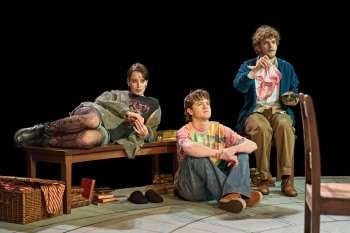
It pains me to write this as I’m a champion of Tom’s, but it would be a dereliction of my duty as a reviewer not to be open, honest and candid. These structural faults inherent in the work are compounded by a production that has some bizarre features. The standout decision is to stage the play in the round. I find it very difficult to follow the nuances and micro moves of characters I can only see the back of. The essence of drama is the face-to-face situation. The face to back of the head situation is a different matter. The second big problem is the sheer cast of characters, of which there are twelve. Many are very central and have many lines to speak. I found it almost impossible to follow. This is compounded by the split narrative. The play moves back and forth between 1809 and the present. The house for the two time periods is the same. The present owners are descendants of the original Georgian family, the Coverleys. I spent so much bandwidth trying to keep up with the plot that I missed so much of the quick-fire witty Stoppard dialogue. And that brings me to what is the elephant in the room.
Stoppard is revered for his wit, sophistication and double helix-like plot juxtapositions, and of course, we all want to be thought of as clever and well-educated. But what no one is prepared to say is that on this occasion, Tom is being too clever by half. He is, in short, name-dropping and showing off. Arcadia is designed to overawe. It is too knowingly brilliant. It takes it for granted that the punters are au fait with, amongst many other things, landscape gardening controversies of the eighteenth century, classical literature and philosophy, Fermat’s Last Theorem, iterated algorithms, free will versus determinism, entropy, Thomas Love Peacock, Thackeray, Lord Byron, Coleridge, Newton’s law of thermodynamics, Leibniz and calculus and so on. For those in the know, this might well be stimulating, but I found it too much, like eating too many Krispy Kreme doughnuts.
The structure of the dialogue is unhelpful and baffling. First, character A holds forth and makes what sounds like a slam dunk. Only for character B to reply with an equally winning mini monologue. It left me with the feeling that Stoppard was playing games of intellectual ping pong with no resolution, as if he didn’t actually believe in anything. My final complaint concerns the party scene after the interval. Noises off include fireworks and a sound system; the volume of both makes it impossible to hear the onstage dialogue.
Of course, Arcadia does have many of the trademark Stoppardian joys. There are many jokes. Fiona Button, as an arch Lady Croom, has the best laugh of the night when she asks her landscape gardener Richard Nokes (Gabriel Akuwudike) why he built a Hermitage without a Hermit? When the latter suggests advertising for one in the Newspaper she brings the house down with her withering riposte: “One could hardly believe in the veracity of a Hermit who took a newspaper.” Stoppard is unmatched when writing in this vein.
Seamus Dillane, as the in-house tutor, Septimus Hodge, has much fun running rings around the cuckolded poet Ezra Chater (Matthew Steer). And it’s his relationship with the child prodigy Thomasina Coverly (the superb Isis Hainsworth) that provides the emotional heart of the play. It’s at once a liberating relationship between an inspirational teacher and a brilliant pupil, but also a warning of the dangers of over-familiarity a la “Notes on a Scandal.” Bill Nighy complained that, try as he might, he never got a laugh for the line “… f***ed by a Dahlia.” And so it was for Prasanna Puwanarajah as Bernard Nightingale, the Sussex University Eng Lit Professor. The reason is that the plot detail is so complex at this point that few audience members know what is going on or what he is referring to.
This half of the plot, i.e., the present day, centres around the battle of wills between Bernard and Hannah Jarvis, writer with independent means and (Leila Farzard) the current Chatelaine of Sidley Park. He resents her status and wealth she dislikes his Donnish arrogance. Their battle is rather like Noel Coward’s song ‘The Stately Homes of England’: “…how beautiful they stand / To show the upper classes have still the upper hand”. Bernard can range all he likes, but it’s Hannah who has the House, the land and crucially the archive. Without her say-so, he cannot get access. This is a wonderful metaphor for England. The past still has a grip on the present. Perhaps the best that can be said of Arcadia is that it requires two viewings after having first read the script. Only then will it reveal its undoubted treasures.

Review by John O’Brien
“Sex, the attraction that Newton left out.”
Brilliant minds, burning hearts and the unstoppable pull between chaos and order.
In a country house, two centuries apart, genius unfolds. A teenage prodigy discovers the mathematics of the universe, as the adults around her fail to hide their passions under reason. In the present day, scholars chase the ghosts of that same household — seeking truth, proof and perhaps each other.
CAST
Gabriel Akuwudike – Richard Noakes
David Buttle – Understudy Bernard Nightingale/Ezra Chater/Captain Brice, RN/Jellaby/Richard Noakes
Fiona Button – Lady Croom
Angus Cooper – Valentine Coverly
Seamus Dillane – Septimus Hodge
Leila Farzad – Hannah Jarvis
Tim Frances – Jellaby
Holly Godliman – Chloë Coverly
Isis Hainsworth – Thomasina Coverly
Heziah Hayes – Understudy Thomasina Coverly/ Chloë Coverly
William Lawlor – Gus Coverly, Augustus Coverly
George Lorimer – Understudy Septimus Hodge/Valentine Coverly/Gus Coverly, Augustus Coverly
Colin Mace – Captain Brice, RN
Prasanna Puwanarajah – Bernard Nightingale
Lizzie Schenk – Understudy Hannah Jarvis/Lady Croom
Matthew Steer – Ezra Chater
CREATIVE TEAM
Sir Tom Stoppard (1937-2025) – Writer
Carrie Cracknell – Director
Alex Eales – Set
Suzanne Cave – Costume
Guy Hoare – Lithing
Donato Wharton – Sound
Ira Mandela Siobhan – Movement
Stuart Early – Composer
Serena Hill CDG – Casting
Nia Lynn – Voice
Anna Ryder – Associate Director
ARCADIA
The Old Vic
24 January to September 2026

