For a show set in Lancashire, far too many characters’ accents were from somewhere significantly further south. Accordingly, this isn’t a show that even attempts Lancastrian dialect, which is probably just as well, as it would have made it somewhat less accessible for those (including your reviewer) unfamiliar with it. Some contemporary references creep in occasionally – the show is set around the time of the infamous Pendle Witches trials in 1612. On balance, it’s difficult to be too critical of the musical’s attempts to connect with a twenty-first-century audience, even if some may take the view that it goes too far with song-and-dance numbers that wouldn’t be out of place if the show had been set four centuries later instead.
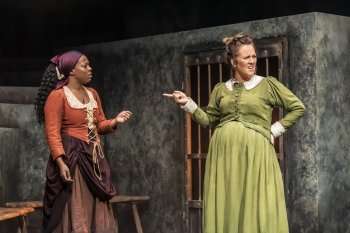
Religion dominated, particularly in the first half, and the musical placed more emphasis on the personal beliefs of individuals sent to the jail at Lancaster Castle awaiting trial than on underlining more widely quite how important faith and spirituality was at the time in society at large. This resulted in the feeling that while (through contemporary lenses, at least) nobody was a witch, some of them might well be fundamentalist fanatics, which in turn somewhat detracted from the injustices these women faced in the first place, having been accused of witchcraft, with the powers that be arresting and charging women on the flimsiest evidence.
This also felt more like a play with songs than a musical, because a fair bit of the narrative was expressed through spoken word. Chronologically speaking, much of the action in the second half takes place before most of the action in the first. At the interval, therefore, you would be forgiven for wanting to leave, because there isn’t enough context to understand, let alone sympathise with, the supposed witches and their inevitable plight.
Patience is rewarded for those who remain, however. The unfairness of the women’s treatment was compounded by the relaxation of regulations, especially for the witch trials: in court cases of other natures, the sole testimony of a child would be unlikely to be relied upon to convict a defendant. The closing scenes are largely devoted to a consideration of the impact the witch trials will have in generations to come. It is simultaneously inspiring and contrived: the former because the women have reason to believe that the history (or her-story) books will eventually tell the truth, the latter because it is unclear where such confidence comes from.
An on-stage band played very well, supplemented by some cast members also with instruments in hand, though I’m not sure why, as it was clear, at least from my vantage point, that not all the instruments were actually being played. Commendably, the show allows the audience to make connections between ‘then’ and ‘now’ for themselves. Miscarriages of justice still occur. But, here, some characters are somewhat underwritten, with at least one carted off to be hanged before I could even figure out who she was in the first place (I’d tell you who it was, but I don’t remember!).
That said, it’s always a good thing when a show doesn’t feel nearly as long as it was. When given the opportunity, which didn’t seem often enough, the cast, individually and collectively, sing beautifully. But the ‘happy ending’, inverted commas mine, doesn’t ultimately feel entirely earned, given that there were no winners in this dark chapter of England’s past.

Review by Chris Omaweng
1612, Pendle, Lancashire. A witch hunt is raging and a nine-year-old Jennet accuses her own family of witchcraft. 21 years later, she finds herself imprisoned, surrounded by the most feared women in town. As the accuser becomes the accused, Jennet must confront a 250-year legacy of witchcraft and the dark secrets of her own past. As she listens to the shocking stories of the women around her, Jennet’s faith begins to crumble.
CAST
Nell / Elizabeth – Allyson Ava-Brown
Ensemble – Rachel Barnes
Jenet – Gabrielle Brooks
Frances / Alizon – Shiloh Coke
King James / Ensemble – Rosalind Ford
Ensemble – Alice Gruden
Martha / Judge – Penny Layden
Ensemble – Holly Mallett
Rose – Lauryn Redding
Ensemble – Kathryn Tindall
Edmund / Covell – Diana Vickers
Maggie – Jacinta Whyte
Keys – Jennifer Whyte
CREATIVE TEAM
Book, Music and Lyrics – Rebecca Brewer
Music, Lyrics and Orchestrations – Daisy Chute
Additional Story Development – Morgan Lloyd Malcolm
Director – Miranda Cromwell
Set and Costume Designer – Jasmine Swan
Lighting Designer – Zeynep Kepekli
Sound Designer – Helen Atkinson
Choreographer – Shelley Maxwell
Puppetry Director – Laura Cubitt
Puppet Designer – Oliver Hymans for Little Angel Theatre
Associate Director – Sofia Gallucci
Casting Director – Pearson Casting
COVEN
Kiln Theatre
31 October 2025 to 17 January 2026

