Curating is not a play for those more traditional theatregoers who like a clear, certain narrative, with a strictly defined beginning, middle, and end.
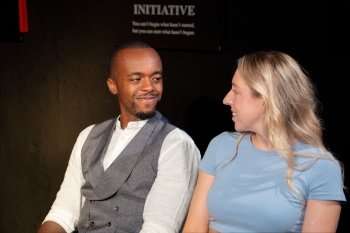
What is on offer here, in this show from 28&2 Productions, is a many-layered, ambitious attempt to combine humour, pathos, confusion and ambiguity in an exploration of the nature of mortality, regret, remorse and the importance of seizing any available second chances…all tied up in a huge amount of bureaucratic red tape.
This is a production that injects confusion and disorientation right from the start, with a lady in typical late Victorian dress vaping as she sits at a modern work station piled with paperwork, a fitfully functioning printer and surrounded by a series of motivational, management-speak posters extolling the virtues of Growth, Patience, Initiative and Confidence; a curious juxtaposition of time and culture that is a foretaste of what is to come.
We then encounter Freya, an aspiring painter currently treading water in a call centre, very definitely a woman of the 2020s in a crop top and jogging bottoms, lying on the floor as if she has been carelessly tipped into the room and left there.
An energetic administrator dashes in offering tea, biscuits, yet no real explanation as to where Freya is (other than in room 208), or why she is there. This scenario becomes the catalyst for the development of the plot, as surrealism mixes with absurdity and uncertainty to drive forward a tale that we can never quite be sure that what we are watching is real.
It soon transpires that Freya is in a waiting room for the afterlife, where souls are documented, processed and prepared for eternity. The administrator is, in fact, a curator, whose job it is to work through the necessary paperwork and red tape to ensure that Freya is effectively processed and is ready for the next stage of her “journey,” whatever that might be.
Freya, suffering from a splitting headache, is, understandably, rather surprised that she has shuffled off the mortal coil and cannot remember the circumstances that led to her sitting in this purgatorial anteroom answering tedious questions from an increasingly tetchy and brusque curator. Her interview becomes increasingly yet amusingly bedevilled by misunderstandings and growing levels of bewilderment.
Suddenly, despairing of the inadequacy of the required paperwork, her Curator dashes out of the room to sort it out, leaving a second lost soul, John, to enter by accident. His own particular processing is proceeding at a somewhat slower rate than Freya’s, as he reveals that he died in 1898.
Their conversation, amusingly suffused by references to the differences between two worlds nearly 130 years apart, takes an unexpectedly darker turn as we learn the tragic circumstances underpinning John’s demise.
This is quite a lot to take in over the first forty-five minutes of a sixty-minute show, and we still have a twist or two and the denouement to come.
The four actors in this dark comedy generally excel.
Helen Cunningham (also the author of the piece), captures Freya’s bewilderment, confusion and general discombobulation at the situation she finds herself in with well-observed aplomb. Hers is a nuanced performance that deftly tracks the development of her empathy for the plight of John with convincing sensitivity.
Gwithian Evans is massively energetic and manically amusing as the Curator, whose brusqueness and devotion to the correctness of his paperwork and the importance he attaches to his administrative efficiency cannot entirely mask his essential good nature, sprinkled with bonhomie and keenness to do the right thing. Indeed, his enthusiasm is sometimes a little too loud and frenetic for the intimacy of the space in which the play is set, but it is a most enjoyable portrayal.
By contrast, Trey Fletcher’s John is calm, understated and quietly compelling, precise in both his movement and his speech. His difficulty in understanding Freya’s world is charming and well executed and provides moments of gentle humour. He also delivers an achingly poignant monologue detailing the heartbreaking reasons underlying his passing.
Andrea Matthea provides strong support as, firstly, the less efficient curator of souls, Matilda, and then as a member of an art gallery staff who might just facilitate Freya’s big break.
All the actors work well together, the dialogue is delivered at a crisp pace, and the different characterisations are all convincing, with a believable warmth and friendship between their mismatched pairs strongly communicated.
There are a lot of ideas in Curating, but not all of them are fully realised. For instance, with Freya and John’s scenes, there is much comic potential to be found in an exploration of the cultural and social differences between the late Victorian and our present eras, yet this was not fully investigated and developed.
There was some repetition of dialogue, which could have been reduced without losing the narrative thread. The early exchanges between Freya and The Curator went on a little too long, and we could have got to the fundamental plot construct that Freya was in some kind of purgatory quicker. The emphasis on the need for accurate paperwork to enter the afterlife is a strong joke, but is one-dimensional and was overemphasised.
The ending of the play will also split opinion. Was Freya really dead, or are we viewing the action through her mind and the hallucinations of her near-death experience? What was real, what was imagined?
Was Freya’s ability to complete the Rubik’s Cube puzzle in the final scene (which got a deserved round of applause) a metaphor to signify that her second chance was going to be successful?
More questions than answers, then, and some may find the deliberate ambiguity of the ending a little unsatisfactory. Others, however, will enjoy drawing their own conclusions about what Freya experienced and what happens next, and appreciate the offbeat dark humour that suffuses this exploration of the challenges of finding meaning in life, death and whatever may constitute the hereafter.
Overall, Curating is a multi-layered and oddly beguiling and intriguing piece of theatre which is well worth a watch.

Review by Johnny Oxford
Freya finds herself in an unexpected waiting room of the afterlife: a desk, three chairs, and a mountain of forms. As she scrambles to make sense of her life before the final deadline, an unlikely encounter with a taxidermist from 1898 may hold the answers they’ve both been searching for.
Curating is a dark comedy about the choices we make (or fail to make), the absurdity of admin that never ends, and what remains when time finally runs out.
Director – Nikoletta Soumelidis
Writer/Freya – Helen Cunningham
Curator – Gwithian Evans
John – Trey Fletcher
Matilda – Andrea Matthea
CURATING
Old Red Lion Theatre
1-2 and 9-10 November 2025

