He Said/She Said, running at The White Bear Theatre, promises an intriguing evening of psychological exploration. Two one act monologues, which have successfully appeared previously on the Fringe circuit, are here brought together as a double bill, each centring on an act of knife violence.
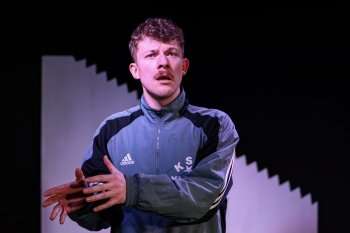
Dom Riley’s Misconduct follows the themes of football hooliganism, and the inherent pressures of coping with changes in established male relationships, seeking meaning in a world of altering alliances and affiliations.
Madeline Gould’s Ladykiller eschews the formalised narrative structure of the first piece and thrusts the audience into a frenzied emotional rollercoaster of a ride through the complicated psyche and past history of a chambermaid who has just fatally stabbed a hotel guest.
These two plays immerse us in the emotional and passionate mental landscape of two very different characters linked by one single act of shocking violence and seeks to delve into the circumstances that led them to this scenario. It tries to develop an understanding of what leads an individual to commit violence and explores their attitudes towards cause and effect, guilt and exculpation and the overall justification for, and acceptance (or not) of, responsibility for their actions.
We begin with Misconduct and meet Richie, a young, loud, brash, aggressive, pugnacious and ostensibly self-confident young man, who switches to and fro during the course of the play from reliving the circumstances of the stabbing in real time, to an explanation to nameless and faceless interrogators about why it happened.
Misconduct, via Richie’s language and behaviours, gives an unvarnished, unfiltered exploration of the worst excesses of football violence and loutish behaviour. Absolutely no punches are pulled in the depiction of Richie, and his interactions with two very different friends, El Tel, the violent leader of this particular football supporting triumvirate, and Mikey, Richie’s best and closest friend, who is palpably moving away both geographically and mentally from the life that he once shared with Richie. Mikey is going to university, and training to be a teacher in faraway Rutland. The trip to Leeds to watch their team play in the FA Cup, is their last hurrah, a trip that Mikey had to be persuaded heavily to be a part of.
Richie is outwardly brash, bellicose and antagonistically self-assertive. Yet, his bullying, battling braggadocio is suffused with an awareness and fear of the disintegration of the old certainties of his life and his relationship with the world, exemplified by the loosening of the ties with Mikey, the one anchor in his life whose imminent departure is setting Richie adrift.
This sense of social disorientation propels him, desperate to “belong,” to hold onto the certainties of the one-dimensional brutal savagery of El Tel. As Richie says, tellingly, “You’ve got nothing left, so you may as well do something reckless.”
Yet, there is the sense that he knows only too well the moral vacuity of this position. Whilst Richie’s invective is coarse and graphic, he occasionally stops and apologises for his language, and there is a degree of humour and self-deprecation that laces his version of events.
Richie is someone that, despite everything, one cannot help liking, or, at least, empathising with. A young man desperately trying to grapple with the true nature of his self-deception underpinning his reaction to the random act of unthinking violence that he has perpetrated. At the end, Richie is only too aware of what he has done…and what he has lost.
Ladykiller is a slightly different kettle of fish. The audience are immediately pitchforked into the aftermath of a murder. A wide-eyed and panic-stricken hotel chambermaid stands breathless, transfixed and immobile, her uniform covered in blood, a knife in one hand and a shoe in the other.
So, we have at first glance a straightforward proposition: a chambermaid, a hotel room, an argument with a hotel guest that swiftly climaxes into a struggle that results in a fatal stabbing. A tragic accident based on a panic-stricken episode of self-defence, or something a little more premeditated, cold-blooded?
This is one of the first unsettling ambiguities that permeate the piece. All is very much not what it seems.
The fourth wall in this monologue is shattered from the very beginning. The unnamed maid addresses the audience directly throughout the play. She maintains unflinching eye contact, throws out casual asides and direct questions putting the audience in a quandary. Are we complicit in the crime that has just been committed? Are we being manipulated by a murderous psychopath, or do we become a sounding board for an exposition of why people kill? How far are we being misdirected?
Following the initial appearance of the character, and her screaming pleas of innocence and self-defence, we become subject to an astounding key change and change of moral and intellectual direction. We suddenly become subject to a different interpretation of what we have just witnessed, as the Maid embarks upon a monologue dripping with cynicism and sarcasm about her own, and societal, portrayal of female victimhood.
Alternately charming, aggressively confident and slyly manipulative, at one moment we hear her assertion “I am the victim here” juxtaposed with “Look, I’m disgusting. And I’m going to get away with it.”
The monologue takes us into the Maid’s back story, detailing her childhood, her loneliness, her difficult relationship with her parents and her devotion to her grandfather. In this way, with significant diversions into the social and economic restrictions placed upon women by the patriarchy, she sets out to justify her own actions, infusing her narrative with an intellectual, yet calculated and explicit detachment from what she has done, attacking the baked in hypocrisy of a system that isn’t able to measure and understand what women are capable of perpetrating in cold blood.
This is a blood-soaked morality tale about exploitation and the power of societal assumptions.
To stand alone on stage for nearly an hour, and maintain the audience’s attention throughout, is no easy feat. The performances of Gwithian Evans as Richie, and Geebs Marie Williams as The Maid, (or “Her” as she is referred to in the programme), are of the highest standard. Confident, engaging, challenging and thoughtful, their portrayals of two flawed characters, struggling to determine their place in life and unable to prevent the ultimate shocking consequences of their actions and choices, are superbly delineated, and powerfully delivered. There is nuanced subtlety, and compelling, authoritative passion in both of their performances.
Director and producer Claire Evans gives full rein to the pace and dynamism of the piece, and the thrust of the narrative.
Despite the danger of a repetition of the themes underpinning both monologues that could dilute their key messaging (especially the case with Ladykiller which might benefit from a judicious pruning of the dialogue to avoid unnecessary duplication of issues), He Said/She Said provides a thought provoking and largely compelling evening of theatre.

Review by Johnny Oxford
Two actors. Two writers. Two acts of violence. These worlds collide only in this theatre space.
Gwithian Evans as Richie in Misconduct
Geebs Marie Williams as Her in Ladykiller
Producer and Director – Claire Evans
Writers – Dom Riley and Madeline Gould
Designer – David Fitzhugh
Lighting Direction/Technical DSM – Marta Fossati
Sound Design – Jan Giedroyc
HE SAID/SHE SAID
White Bear Theatre
21 April to 2 May 2026

