As part of Mime London’s 2025 season, French-Norwegian theatre company Plexus Polaire brings Herman Melville’s epic novel Moby Dick to the Barbican stage, inventively evoking the vastness and mystery of the ocean and combining it with a merciless view of human obsession via a breathtaking blend of large-scale puppetry, video projection, live music, and drama.
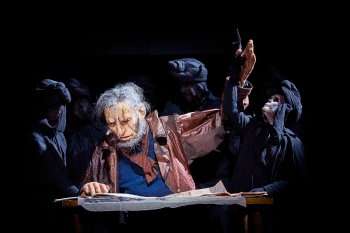
Under the direction of Yngvild Aspeli, the production follows Captain Ahab’s relentless pursuit of the great white whale, a journey into ambition, obsession, and the enigmatic power of nature.
The vitality and realism of the piece is established from the start, with flashes of a shoal of tiny fish whipping through the ribs of a whale carcass deep underwater. It takes a few seconds to realise that the fish are puppets, effortlessly manipulated to portray their mix of slow undulations and sudden frenetic movements to dizzyingly lifelike effect.
This dextrous opening sets the standard for 85 minutes of astonishing and mesmeric theatre, creating an assault on the senses that immerses the audience into Melville’s epic narrative.
The virtuosity of the puppeteers is stunning. Whether depicting humans, whales, sharks, mermaids, or ships, the cast expertly move their charges with intense care and attention to detail. Be it recreating the movement of a sperm whale, the mannerisms of the haunted Captain Ahab, or simply communicating the relationships between crew members via a subtle series of head tilts and arm movements, the puppetry is of the highest order.
The production also deftly uses filmic techniques to influence the audience’s eyeline effectively playing with scale and perspective. Puppets of varying sizes create the illusion of different camera angles to establish close-ups and long shots, sometimes being manoeuvred at ninety-degree angles to create an aerial or side-on view of the action. In this way, the narrative contains and maintains all the visual interest of a feature-length film.
Yet, the skills of the puppet manipulators are only half the story.
The lighting, designed by Xavier Lescat and Vincent Loubière contributes hugely to the immersive nature of the production, delivering a brooding, claustrophobic darkness evoking the depths and mystery of the ocean, ensuring that the puppets remain brightly illuminated, whilst the puppeteers fade almost completely into the darkness of the stage.
This production is immeasurably enriched by the music. A double bass, drums and guitar craft intricate seascapes filled with whale songs, crashing waves, and the screech of seagulls, as well as providing melodic, soaring voices at appropriate moments.
The lighting and music combine to underpin the unfolding narrative with a disturbing, feverish, dream-like ethereal quality.
The production pulls no punches in its depiction of the savageness of nature, and man’s interrelationship with it. The brutality of whaling is depicted in gory detail.
The death-by-harpoon of a mother whale is searingly memorable. The images of her body rotating in the water as the flesh is peeled back from the carcass before the head is detached and the rest of the body drifts slowly to the ocean floor accompanied by the calf she was nursing lives long in the memory. Similarly, the frantic gnawing at the carcass by a swarm of hungry sharks lays bare the reality of nature red in tooth and claw.
Herman Melville’s opus is, famously, not an easy read, and it is fair to say that those that are familiar with the novel may fare a little better in following the narrative. At times the language delivered by Ishmael becomes densely philosophical, while some details, such as the prophecy Ahab is told by the angels of death, first mate Starbuck’s wrestling with his conscience and his loyalty to Ahab before the final encounter with the white whale, or the allegorical characterisation of the innocent Pip, are rather abstruse and get a little lost.
Having said this, it is not necessary to have read the novel to be swept up by the story, to marvel at the ingenious melange of theatrical techniques applied, and to become thoroughly immersed in this production. The 85 minutes fly by.
That such a thrilling, engaging, vast sweep of a production, (featuring over fifty puppets and a life-sized whale) should be performed by seven actors and three musicians is an astonishing testament to their dexterity, energy, and professionalism.
This is a theatrical experience of the highest order.

Review by Johnny Oxford
CAST
Actors and puppeteers Alice Chéné, Daniel Collados, Olmo Hidalgo, Scott Koehler, Maja Kunsic, Laëtitia Labre and Julian Spooner
Musicians Ane Marthe Sørlien Holen, Guro Skumsnes Moe and Havard Skaset
CREATIVE TEAM
Director Yngvild Aspeli
Puppet Makers Polina Borisova, Yngvild Aspeli, Manon Dublanc, Sébastien Puech, Elise Nicod
Set Designer Elisabeth Holager Lund
Lighting Designers Xavier Lescat and Vincent Loubière
Video Designer David Lejard-Ruffet
Costume Designer Benjamin Moreau
Lighting Technicians Vincent Loubière and Marine David
Production Manager Simon Bird
Video Technicians Hugo Masson, Pierre Hubert and Emilie Delforce
Sound Technicians Raphaël Barani, Simon Masson and Damien Ory
Stage Technicians Benjamin Dupuis, Xavier Lescat and Margot Boche
Assistant Director (on tour) Benoît Segui
Assistant Director (in rehearsals) Pierre Tual
Dramaturg Pauline Thimonnier
Production Director and Tour Booking Claire Costa
Administration Anne-Laure Doucet and Gaedig Bonabesse
Producer Noémie Jorez
PLEXUS POLAIRE: MOBY DICK
Barbican Centre
22 to 25 January 2025

