Desire, Defiance, Decapitation.
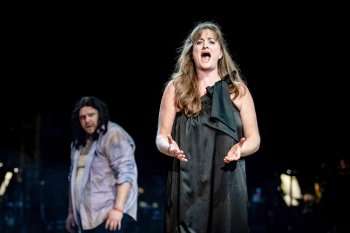
The famous York Hall, home of British boxing, is a fitting venue for Salome. An opera with a knockout punch. Many boxers have suffered cuts and knockout blows here, but none has been decapitated. Yet that’s what Salome insists on as her reward for pleasing her father. She is the daughter of King Herod (yes, that Herod) and a Princess of Judea. That’s some title. Indeed, that title gives her a sense of entitlement which drives this extraordinary opera to its shocking and bloody denouement. Salome is used to getting what she wants. She knows she is beautiful. She knows she can get others to do her bidding. She is supremely sensuous, sexy and seductive. What happens when Salome comes up against someone who will not do as she wants? That’s the tragedy at the heart of Strauss’s opera. Her nemesis is John the Baptist. Referred to here by the wonderful Hebrew Jochanan, meaning God’s Grace. So, we have power versus principle. It’s a fantastic, dramatic confrontation. Made all the more exhilarating by orchestral music, spine-tingling voices, a strong cast, a unique venue and in Scottish soprano Eleanor Dennis, a spellbinding Salome. This show is not one for the faint-hearted, but if you like blood, guts and gore, then this is right up your street.
Salome is all about looking. If Looks Could Kill might be an alternative title for the opera. Desire starts with a look and Salome knows that. She’s used to being looked at. Characters in the opera keep reiterating the refrain “stop looking at her.” It starts with a look and ends with a decapitation, which, in a nutshell, is the story of Salome. This Princess of Judea is miffed that Jochanan (Joseph Gansert) does not want to look at her or have her look at him. Puzzled by this, she insists that Narraboth (James Schouten), an important courtier, opens up Jochanan’s prison cell. Salome uses all her sexual power to persuade Narraboth to do so. Now she comes face-to-face with Jochanan. Despite using her full repertoire of seductive tricks, Salome cannot get Jochanan to kiss her. This encounter is one of the opera’s most intense episodes. As Salome goes up the seduction escalation ladder, she itemises each of his features in turn, but no, Jochanan is not interested. This is the first act of Defiance. Now comes the opera’s peripeteia. From sexual seduction, Salome switches to vindictive vengeance. She will turn to Daddy to get what she wants. She can wrap him around her little finger. In a scene of almost textbook Freudian father-daughter dynamics, she dances for him. Her reward for doing so is anything she wishes. Her wish is the head of Jochanan on a silver platter. The King pleads with her. Salome refuses to budge. This is the second act of defiance. The finale, clearly analogous to a sexual climax, is of Salome holding the head of Jochanan. The colour contrast of her black shift and the red bold flowing from his head is shocking, stunning and startling. It’s a real coup de theatre. Salome’s moment of triumph is both a victory and a defeat. Yes, she realises her desire to kiss him on the mouth, but she notices to her dismay that he’s not looking at her. The thing she craves above all, to be looked at, eludes her. It’s a devastating psychological ambivalence.
The staging of Salome is well thought out. The action takes place in the round with the stage area in the same place as the boxing ring. This gives good sightlines for punters. The orchestra occupies the stage at the front of the hall. We can see them play, should we choose to, and the acoustics are such that the sound travels uninterruptedly through the hall. Ben Woodward conducts with vigour and intensity. Hannah Schmidt’s set and costume designs are highly effective. I have just one complaint. The advance publicity gave a time of ninety minutes with no interval. Last night it was 105 minutes with no interval. Asking audiences to sit for that long without a break is asking a lot. I would have preferred an interval.

Review by John O’Brien
York Hall in Bethnal Green is transformed into an intimate performance arena, drawing audiences startlingly close to the action. The proximity heightens the opera’s psychological charge: desire becomes claustrophobic, violence feels inescapable, and the political tensions of Herod’s court press in from all sides.
Nigel Shore’s chamber reduction of Strauss’s monumental score gives the music a raw, visceral edge. Every motif, every surge of orchestral colour, is experienced at close range — a perfect match for Oscar Wilde’s once-banned play, whose themes of lust, prophecy and fatal fascination remain as potent today as they were at its scandalous premiere.
10th, 18th and 21st April Cast:
SALOME Kirsty Taylor-Stokes
HERODES Robin Whitehouse
HERODIAS Mae Heydorn
JOCHANAAN Freddie Tong
THE PAGE Jess Ouston
11th, 19th, and 23rd April Cast:
SALOME Eleanor Dennis
HERODES Robin Whitehouse
HERODIAS Deborah Humble
JOCHANAAN Joseph Gansert
THE PAGE Natasha Elliott
All shows:
NARRABOTH James Schouten
JEWS Davide Basso, Howard Hutt, Jonathan Finney, Dominick Felix, Andrew Tinkler
NAZARENES Felix Kemp, Adam Sullivan
SOLDIERS Jacob Ng, Felix Kemp
A CAPPADOCIAN Gerard Delrez
A SLAVE Annabel Bigland
Creatives
DIRECTOR Mark Ravenhill
CONDUCTOR Ben Woodward
CHOREOGRAPHER Aletta Collins
SCENIC DESIGNER Hannah Schmidt
LIGHTING DESIGNER Azusa Ono
Regents Opera presents
SALOME
York Hall, Bethnal Green
10 to 23 April 2026 (selected dates)

