The Finborough Theatre has five ‘playwrights in residence’ and is currently staging the latest play by one of them, Athena Stevens, the fifty-minute-long Diagnosis, which makes for a short, if interesting, evening.
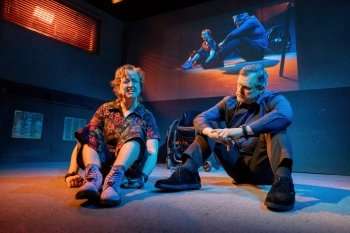
It is set in a police interview room, some time in the future,e where “She”, a disabled woman of about forty years of age, is about to be interviewed by an “officer”. She is employed, like other disabled people, as a Drone Operator who sits at home and flies drones through London Underground tunnels to see if there are any structural faults. This work, though essential, is invisible, isolating and often dismissed as low status, despite the lives that depend on it. So, when She spots weaknesses in the District Line tunnel that runs just below the level of the Thames along the Embankment near Villiers Street, she is not believed and, when the play opens, has just assaulted someone so that she can be arrested and interviewed by the police. In this ‘state of the future’, there are even more rules and regulations about how the police conduct interviews, including the use of a Citizen Supervisory Panel – the audience – who have to observe police interviews.
Although there are four characters in the play, one a ‘Rookie’ police officer (Ted Walliker) is rarely seen but heard several times by radio, and the other, a Videographer (Lev Govorovski), does not speak and is permanently down stage left on camera duty, so it is in reality a two-handed play.
Ché Walker is Officer, quickly growing into his role and creating a believable, compassionate person in spite of some rather trite dialogue at times, especially in the first few minutes. He also directs the play.
The playwright, Athena Stevens, is She, forever trying to get Officer to understand the urgency of the situation as she sees it and failing time after time. The potential disaster is so great that Officer just cannot comprehend it. The play is well constructed and builds to a satisfying climax, even if the ending is slightly underwhelming.
The audience needs to focus on the two protagonists, who have great rapport, especially in the scene where they are both sitting on the floor – this is particularly believable and poignant.
However, this necessary focus is diminished by the video design (Rio Redwood-Sawyerr), which continuously projects live images of both protagonists on the rear of Juliette Demoulin’s excellent set, often with “effects” so that one does not know whether one is supposed to be looking at the actors or the video!
The aforementioned focus is also affected by a continual ‘soundscape’ or underscoring (Julian Starr) which often makes it difficult to hear clearly what is being said, especially when echo effects are used, blurring the actors’ enunciation on purpose!! I found it irritating.
To a lesser extent Mark Dymock’s lighting design also destroys the focus as there are unnecessary lighting changes, presumably made to heighten the tension, which they don’t, especially when, for example, She is lit in an orange glow, which just does not make sense! Downstage left is a small television screen on which appears the complete script as it is spoken, or in reality,y about fifteen seconds later. It is not clear if the audience is supposed to be able to see/read this screen or not: if it is, the screen is far too small: my colleague who is much younger and fitter than I am, found it annoying because the print was just too small for her to read: I was able to read it, but could still not understand its purpose!
The play itself has much to say about how we view not only disability but also the position of the State in Society, as well as laws which are supposedly there to protect all of us, but it did seem over-directed, as if the director did not trust the play. The impact of Diagnosis would have been much stronger staged simply without expensive sound and video effects; then we could have really focused, so to speak, on what the playwright intended us to!
In spite of my reservations, the play is still worth seeing: it is, on the whole, well written and strongly acted.

Review by John Groves
A London police station, late at night. A vulnerable woman with a disability is brought in. But is she making a confession, a plea, a threat, or is she just plain mad?
After spending years flying surveillance drones through the tunnels of London’s Underground, she begins seeing things – glowing words above people’s heads, predicting their future injuries and diagnoses.
And when she sees a countdown above a stranger’s head at a bar – one that’s ticking down in minutes – she knows she has to act…
Cast – Athena Stevens, Ché Walker, Ted Walliker
Writer – Athena Stevens
Director – Ché Walker
Set Designer – Juliette Demoulin
Lighting Designer – Mark Dymock
Sound Designer and Composer – Julian Starr
Sarah Lawrie for Aegis Productions in association with Neil McPherson for the Finborough Theatre presents
DIAGNOSIS
Finborough Theatre
13 May to 7 June 2025
