There is much more than meets the eye to The Royal Shakespeare Company’s reimagined adaptation by Laura Wade of W Somerset Maugham’s The Constant Wife.
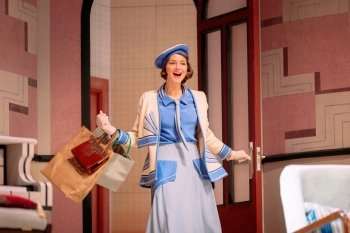
At one level, the play is a frothy, amusing comedy of social manners and marital manoeuvres, played out in a pastel-themed, art deco light and airy drawing room redolent of the gentility and understated sophistication of 1920s upper middle-class London society. Characters glide past a transparent “wall” in elegant costumes perfectly evoking the time and place in which the action takes place. This is a world of drinks cabinets, comfortable sofas, grand pianos, cigarette cases and diaphanous scarves.
There is more than a hint of Coward and Wilde in the construction of the plot, with sparkling dialogue and witty aphorisms peppering the narrative.
However, as the action progresses, we realise that there is quite a lot of grit in this particular oyster, as bitter truths and psychological insights about marriage, fidelity and the role of women in society bubble just under the surface and eventually rise to determine the future of this particular “constant wife”.
Constance Middleton appears to have it all. Determined to maintain her financial independence from her wealthy surgeon husband, John, she is forging an extremely successful career as an interior designer, after setting up in business with her sister.
With her daughter recently settled at boarding school, and all seems smooth and tranquil.
However, Constance’s husband is having an affair with her vivacious best friend, Marie-Louise. Constance has secretly known about this for some time, and rather than playing the role of the passive, humiliated victim, she decides to take matters into her own hands and deal with the issue in a progressive and beautifully nuanced way. She initially denies the affair, defends her husband and his mistress, and then sets about turning the situation to her own advantage, cocking several snooks at conventional belief systems and prevailing societal orthodoxy in the process.
In navigating this particular set of obstacles, Constance is not short of familial advice, coming from very different directions. Her reactionary mother is aghast that Constance should even consider confronting the philanderers, and should conform to the prevailing social mores of the day, whilst her distinctly feminist-leaning sister is equally appalled that Constance might passively do nothing and maintain the stultifying status quo thereby perpetuating the predominance of intrinsically unfair sexual double standards in favour of the male.
In reality, Constance needs no advice as to how to deal with the situation, and draws inspiration from her impeccably behaved butler, Bentley, who, it appears, has secrets of his own…
The presence of former beau Bernard Kersal, back in London after many years in Japan, provides Constance with both the motive and opportunity to reset the situation and shape the final outcome very much to her own advantage.
At the very heart of the show is Kara Tointon’s wonderfully balanced and nuanced portrayal of Constance. Graceful and vulnerable (especially when thinking of her daughter far away from home at her new school), yet sharply wry and penetratingly clear-sighted, Constance maintains her sang froid through a year of her husband’s infidelity with a charm and elegance that never wavers. A demanding role that Tointon navigates effortlessly.
Tointon is supported by a strong cast, particularly Sara Crowe as her mother, Mrs Culver, and Amy Vicary-Smith as her sister, Martha, who both provide superb foils to Constance’s composure, between them offering a sparkling commentary on the world of gender equality, love, monogamy and fidelity.
Crowe delivers her acidic bon mots with exquisite relish. Her traditional views of the human condition, and the supremacy of the male in society in general and the marriage contract in particular, are laid out in the observation that “If a husband neglects his wife, it is her own fault”. Referring to Constance, Mrs Culver opines that she cannot be miserable as “…she eats well, sleeps well, dresses well and she’s losing weight. No woman can be unhappy in those circumstances.”
In contrast, the fiery no-nonsense Martha crisply disparages social conventions and urges Constance to behave as a liberated woman in the modern world should. Martha is both fiercely protective of her sister and totally exasperated by her.
Vicary-Smith also earns a well-merited round of applause from the audience for her strikingly energetic and detailed reprise of the plot so far at the beginning of Act Two. A peroration that sets the pace for the unfolding of the narrative from thereon.
The men, true to the script, are portrayed studiously and effectively as very much shallow and one-dimensional, rather stolid characters, in contrast to the dynamism and vivacity of the Middleton women.
There are some deftly and perfectly timed moments in this production. The transition in Act One, which takes us back one year to the moment of Constance’s realisation of her husband’s affair, is well delivered. Similarly, Constance’s melodramatic hurling of her handkerchief onto the piano to warn her mother to leave the room so she can be alone with Bernard, only for her mother to misinterpret the melodramatic gesture, is perfectly timed. The delicious irony of Constance being thwarted in her attempts to see the play The Constant Wife by the development of her own personal circumstances is nicely managed and amusingly pointed.
The Constant Wife succeeds on a number of levels. On the one hand, this is a piercingly sharp, well-observed comedy of manners, with a consistent sprinkling of incisive, funny one-liners and comic set-ups, which is perfectly framed by the consistent quality of the pacy dialogue.
Yet this is much more than a frothy, gentle warm bath of a satire poking fun at the whims and sins of the privileged upper classes. Amongst the witty badinage, the narrative is salted with a pointed critique of the quintessential unfairness and baked-in hypocrisy of modern society, with the enduring toxicity of the assumptions underlying the concept of male primacy, supremacy, and pre-eminence in socio-economic and emotional constructs comprehensively laid bare. Although written in 1926, there is much here that resonates with an audience in 2026.
Difficult questions regarding infidelity, women’s lack of financial independence and the continued lack of balance and equality in gender equalisation are raised in this play, and, although sugar coated in sparkling dialogue and engagingly entertaining comedic set ups, the key question of how far we have actually progressed in sexual and socio-economic parity remains as the thought-provoking message to be taken away from this warm-hearted production.

Review by Johnny Oxford
1927. Constance is a very unhappy woman. “Nonsense” says her mother “she eats well, sleeps well, dresses well and she’s losing weight. No woman can be unhappy in those circumstances.” Constance is the perfect wife and mother, and her husband is as devoted to her as he is to his mistress, who just happens to be her best friend.
Kara Tointon – Constance Middleton
Jules Brown – Mortimer Durham
Tim Delap – John Middleton
Alex Mugnaioni – Bernard Kersal
Gloria Onitiri – Marie-Louise Durham
Philip Rham – Bentley
Amy Vicary-Smith – Martha Culver
Sara Crowe – Mrs Culver
With Sam Flint, Jocasta King and Jane Lambert
Laura Wade – Writer
Tamara Harvey – Director
Anna Flesichle – Set and Co-Costume Designer
Jamie Cullum – Composer
Cat Fuller – Co-Costume Designer
Sally Ferguson – Lighting Designer
Claire Windsor – Sound Designer
Francesca Murray Fuentes – Associate Director
Angelica Rush – Associate Designer
Annie-Lunnette Deakin-Foster – Movement Director
Sarah Bird – Casting Director
Mark Frankum CDG – Casting Director
THE CONSTANT WIFE
Richmond Theatre, 9 to 14 February 2026
Tour continues to 16 May 2026

