When I was a student in the 1980s, the Thatcher government was planning to abolish student grants. This sparked a wave of dissent and I, along with many others, joined protest marches, tramping through central London chanting, ‘Maggie, Maggie, Maggie, out, out, out!’ Even though we made absolutely no difference to government policy (sorry kids), there was something powerful about having a common cause with like-minded people – united in our aims, loud, visible, taking a stand… And yet, for the subsequent forty years, the most I have done to campaign for change is sign the odd petition. Did life, work,and responsibility simply get in the way? Has the world changed, or have I? What would it take to rekindle that spirit of protest, and what would it mean for me, my loved ones and the choices I might make about my life?
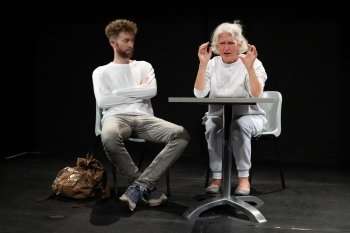
Questions like these are at the heart of Can’t Kill the Spirit, an engaging new play by Robert Gordon Clark now showing at Waterloo East Theatre. It tells the story of Chloe, who, as the play opens, is on remand for a climate-action protest that has gone tragically wrong. But Chloe, played with conviction by Lisa Day, is not a ‘typical’ eco-warrior. She is a neat, almost demure, grey-haired, middle-aged woman who has spent the last four decades establishing a career and raising a family. But before that, in the eighties, Chloe was one of the Greenham Common protestors who surrounded a US airbase in Berkshire as part of the campaign for nuclear disarmament. Now, here she is, back on the front line of direct action, refusing bail, facing jail time.
It may be hard for younger readers to grasp the scale of the Greenham Common action. Tens of thousands of protesters, almost all women, encircled the base. They camped outside it for years, mass trespassed dressed as teddy bears, and stuck pictures of their children on the fence. They were demonised and many were arrested, but they stuck at it, and arguably it was a very successful campaign, spawning copycat action in other countries and quite probably having a key influence on the treaties which led to the removal of ground-launched nuclear missiles in 1991. It certainly achieved more than a few scruffy students did with our ‘Grants not loans’ banners.
In the play, Chloe has reignited the flame that led her to Greenham Common, thanks to her activist son Joe (played by Sam Ebner-Landy) and an (unseen) old friend who, it is implied, never lost her spark. She tells her confused husband Mark that the potential climate disaster is more important and more urgent now than the threat of nuclear war was back in the day, but the subtle and well-balanced script raises doubts about her motivation. Is Chloe covering up for someone else? Is she really committed to the cause or simply looking for a way to recapture the energy, camaraderie and passion she had in her youth? “We all have our secrets,” she tells Mark as he struggles to understand.
Mark’s journey is the core of the play. Chloe has already decided who she is and what she wants to be, but it all comes as a shock to her husband, who cannot see why their life together isn’t enough for her anymore. It was a common criticism of the Greenham women that they weren’t really in it for their families because, if so, why had they abandoned them to go and protest? This is all echoed by Mark as he pleads with or cajoles Chloe to change her mind. Mark is a bit controlling and a bit patronising, but thanks to the three-dimensional script and the performance of Roger Beaumont, he manages to remain a sympathetic character. Unfortunately, where Mark should be doing the emotional heavy lifting in the play, Beaumont presents a character with an ever-present air of low-key befuddlement, saving himself for one big emotional outburst towards the end. I’m guessing that the director Lucey Aley-Parker felt that keeping Mark’s tone more measured for most of the performance would add weight to the point when the bubble finally bursts. Personally, though, I would have liked to see more emotion and growing intensity brought to the rest of the performance.
Simply staged and set mostly in Chloe’s prison cell, the drama comes purely from the words and the performances. In between scenes, there is a slideshow of pictures from various protests. At first, these are clearly from the 1980s, but eventually you realise that modern pictures have crept in. The cause may be different, but the photos look very familiar – earnest young protestors, implacable riot police. At a time when Extinction Rebellion and Just Stop Oil are still making headlines, and in a week when protestors have been jailed for breaking into an Air Force base and vandalising the planes, it all seems very relevant.
Can’t Kill The Spirit doesn’t answer all the questions it raises, but life is like that, and one person’s new beginning can be another’s unhappy ending. With intelligent writing and solid performances, this is a thoughtful and thought-provoking play that treats its audience like grown-ups.

Review by Chris Gilbert
Can’t Kill The Spirit follows Chloe, a Greenham Common activist who reclaims her voice of protest, forty years after her experiences at the Peace Camp – where thousands of women lived and protested between 1981 and 2000. When a climate demonstration leads to life-changing consequences for her and her family today, Chloe must decide where her priorities lie.
Inspired by women of protest then and now, Can’t Kill the Spirit is a moving story of reconciling personal and global choices and a timely reminder of the need for upstanders in a world of bystanders.
Lisa Day as Chloe
Roger Beaumont as Mark
Sam Edber-Landy as Joe
Written by Robert Gordon-Clark
Directed by Lucy Aley-Parker
Producers – Lucy Robinson, Doug King
Lighting Designer – Andrew Whadcoat
Sound Designer – James Connor
Costume Designer – Jenny Richardson
Composer – Sara Jasmin Page
CAN’T KILL THE SPIRIT
Waterloo East Theatre
2 to 13 July 2025

